


“Feminism” wears many hats. In some circles, it is the no-brainer idea that women are of equal value to men. In other places, it carries a more radical banner that advocates for all kinds of things, ranging from abortion, to casual sex, pornography and beyond. The terms “feminist” and “feminism” are so muddled it can be difficult to pin them down. Feminism claims to speak for women’s best interests and advocate for justice in the public square. As the Catholic Church is pro-life and is also concerned with social justice, the question arises: Can there be a pro-life form of feminism that Catholics can embrace, a form of feminism that trumpets the Gospel’s joyful news of God’s tender care for all His creation?
I step out on a branch here and answer “yes” and my answer hinges on the genesis of the women’s liberation movement (a term I will use interchangeably with feminism).
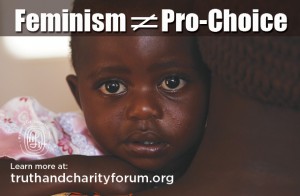 There have been various “waves” of feminism. Two are widely acknowledged. The first is so-named First Wave Feminism and is the movement of the nineteenth and early twentieth century suffragettes, of Elizabeth Cady Stanton, Susan B. Anthony and others who first fought for voting rights and the freedom to participate in civic life. These heroic ladies were pro-life to the core. Serrin M. Foster’s “The Feminist Case Against Abortion” cites their witness noting that they “classified abortion as a form of ‘infanticide’ and, referring to the ‘murder of children, either before or after birth,’ said, ‘We believe the cause of all these abuses lies in the degradation of women.’” Their commitment to equality, dignity and the value of life makes this first wave very solid, a movement any person of good will can endorse.
Then came Second Wave Feminism, which began in the mid-twentieth century and was and continues to be very concerned with women’s gifts and professional life. Betsy Friedan’s The Feminine Mystique (1963) typifies second wave feminism with its excoriation of the “drudgery” of homemaking and childrearing. It calls for women to enter the workforce. Freidan also says this: “The only way for a woman, as for a man, to find herself, to know herself as a person, is by creative work of her own.”
Freidan’s term “creative work” can lead us astray. I fully agree that women, like men, because of their shared humanity find great value in “creative work”. However, to the popular culture, “creative work” is typically understood as a paid profession. To say that women must enter the workforce to have value fails to heed women’s intrinsic value. Women have value for simply being human beings in whichever “work” they may engage in.
Then came the newer, less-defined “third wave” feminism at the beginning of the millennium. This form of feminism inhabits universities’ Women’s Studies programs. It includes a variety of ideas, some of which elevate women’s traditional roles and teach that women actually have different (and/or superior) modes of thought to men. It focuses on experience. In other strains, it demands that to be liberated, women must be sexual creatures who express their freedom by engaging in casual sex, watching or performing in pornography and otherwise owning their bodies, or so goes the parlance. Third wave feminism is thus a mixed bag with no unity. Some of its outgrowths are glaring moral problems that sanction intrinsically evil actions. And yet, when it does acknowledge the actual differences between men and women, it starts to walk down the right path, though the declaration of women as superior goes overboard.
Somewhere in between second and third wave feminism, the women’s movement allied itself with abortion proponents as a means to advancing women’s equality in society, particularly through the work of Gloria Steinem. But the equality here was a false one. To be equal, it said, women have to do the things men do: work outside the home, not be pregnant, not raise children (at least during work hours). This fails to ascribe any value to women’s distinct role in human reproduction. On the contrary, this type of “equality” makes men’s role the standard of goodness; it says the things men do are better, so women must do them too. It neither values women’s uniqueness nor affirms that women’s uniqueness is actually good. Because it cannot affirm that women’s difference is good, this line of reasoning starts to attempt to sweep real differences between the sexes under the rug.
More recently, some new groups have sprung up claiming the mantel of feminism while affirming life as well. They emphasize, “non-violence”, and “pro-woman, pro-child, pro-family.” Granted, these newer voices may not yet have the momentum to qualify as a movement, [though who defines a movement anyway?] but these are promising signs! Modern ladies are challenging the abortion-centered approach of the prominent feminist organizations National Organization of Women (NOW) and NARAL Pro-choice America:
Erika Bachiochi recently published an essay called “I’m a Feminist and I’m Against Abortion.” She notes the contradiction of feminist support for abortion:
But abortion, which is often the assumed solution to unexpected pregnancy in our culture, attempts to cure that sexual asymmetry: the biological fact that women get pregnant and men don’t. It does this by putting the responsibility to care for — or dispense with — the life of a nascent, developing human being on women alone.
Abortion expects nothing more of men, nothing more of medicine, and nothing more of society at large.
And to cite again Foster’s The Feminist Case Against Abortion: “In all its forms, abortion has masked—rather than solved—the problems women face.” Their voices join the chorus of the Church in acknowledging that abortion harms women and therefore stands as a barrier to authentic growth for women.
Pope St. John Paul II, in his 1995 Letter to Women, provides a Catholic lens for understanding the women’s movement. In this short piece, he addresses “women’s liberation.” On the whole of “the great process of women’s liberation,” John Paul declares it thorny but positive and still unfinished.
He acknowledges that there have been missteps in the women’s movement; specifically he mentions that harms to women linger even “in societies which are blessed by prosperity and peace and yet are often corrupted by a culture of hedonistic permissiveness (6).” This refers to the casual sex and pornography so prominent now in the West which some camps of the Third Wave feminists endorse.
At the same time, John Paul II’s letter invites us to recall that the Church is truly the ally of all authentic human goods. He thanks all women: mothers, wives, daughters, sisters, working women and consecrated women then offers his explanation of the nexus of women’s value, which, of course, is based in God, in being created in the image of God. After recalling the story of creation, he says:
“The creation of woman is thus marked from the outset by the principle of help: a help which is not one-sided, but mutual.… men and women are complementary. Womanhood expresses the “human” as much as manhood does, but in a different and complementary way.” (7)
This formulation that John Paul speaks on behalf of the Church is truly the best of all the insights of feminism at once. It proclaims the difference of women, which is a certain truth, while affirming the equality in rational nature and value. While every woman and man is different, we are equal without being the same.
And then, in the spirit of the loftiest of feminism’s aims, John Paul II calls on a growing presence of women in society to transform the world:
“A greater presence of women in society will prove most valuable, for it will help to manifest the contradictions present when society is organized solely according to the criteria of efficiency and productivity, and it will force systems to be redesigned in a way which favours the processes of humanization which mark the ‘civilization of love.’ “(Letter to Women 4)”
This call is earth-shattering in it ideals and simplicity! Pope Saint John Paul II believes that an authentic presence of women in society will help manifest a more Christian, a more human-centered culture–a “civilization of love”. What higher ideal could any movement (feminism) or otherwise call us to?
So to answer the question of whether or not there can be a pro-life feminism, the answer is yes, but that the Church’s “yes” goes far beyond affirming the life of children in the womb. We can celebrate the goodness and uniqueness of women, as good feminism does, without endorsing any of the missteps.
 Stephanie Pacheco is a freelance writer and convert from Northern Virginia. She earned a M.A. in Theological Studies, summa cum laude, from Christendom College and holds a B.A. from the University of Virginia in Religious Studies with a minor in Government and Political Theory. Her work has been featured in America Magazine, Crisis Magazine, Soul Gardening Journal and syndicated by EWTN and Zenit. She blogs about making sense of the Catholic Faith in modern life at theoress.wordpress.com and lives with her husband and two young children.
- The Communists are Right: The Family Is The Basic Cell Of Society. But Here Is Why Their Solution Is Wrong
- Book Review: The Choice of the Family, an Interview with Jean Laffitte
- The Presidential Candidates on Environmental Stewardship
- The Desert Spirituality of Motherhood
- Advent in the Family: A Transmission of Values


