


The Catholic world was shaken upon the release of Walter Cardinal Kasper’s The Gospel of the Family, in which he proposed that the Church permit divorced and civilly remarried Catholics to be admitted to Eucharistic Communion.
Remaining in the Truth of Christ, officially released today, is the thorough and charitable response to Cardinal Kasper’s proposal, both for the arguments presented and for an exhaustive index of relevant Magisterial teaching presented therein. In short, it is required reading to complement our required praying during the Extraordinary Synod on the Family that is currently underway, and its aftermath.
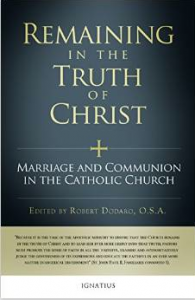 This valuable work contains contributions from Walter Cardinal Brandmüller; Raymond Cardinal Burke; Carlo Cardinal Caffarra; Velasio Cardinal De Paolis, C.S.; Robert Dodaro, O.S.A.; Paul Mankowski, S.J.; Gerhard Cardinal Müller; John M. Rist; and Archbishop Cyril Vasil’, S.J.
The divorced and civilly remarried are those persons who after contracting a valid marriage under the laws of the Church and being unsuccessful in their marriage, obtain a civil divorce and contract a second (or further, at times) civil marriage, as Cardinal De Paolis explains. As the authors of this work clearly show, however, Cardinal Kasper’s proposal cannot be reconciled with Catholic doctrine of the indissolubility of marriage. We are confronted with a widespread ignorance today in Catholics’ understanding of marriage, so before we contemplate reformulating Church teaching we have an obligation to actually share that teaching with those who are going to get married, and those who consider these questions in good faith.
The New Testament shows how Christ condemns remarriage after divorce as adultery, as Father Mankowski points out. Even before this, we find in Genesis “Therefore a man leaves his father and mother and cleaves to his wife, and they become one flesh” (Gn.2:24). This is a teaching that is extrahistorical and universal, illuminating the essence of marriage. This is the way in which Jesus explains this passage in his dispute with the Pharisees. Christ is the Word made flesh, the Lawgiver Who brings the Old Testament teachings to their fulfillment and perfection. He clearly teaches that divorce and remarriage are contrary to God’s plans. In the Gospel passages that treat of divorce, the condemnation of remarriage is always absolute. The so-called exception clause of “immorality” is well explained as incest, so that in that case, there is not a valid marriage, as is clearly explained by Fr. Mankowski. The Catholic Church has always based her doctrine and practice on the teachings of Christ concerning the indissolubility of marriage.
The experience of the early Church is conclusive in its rejection of divorce and remarriage, as Professor Rist demonstrates, an overwhelming majority of the patristic writers reject this possibility, with very rare exceptions. Here is important to insist that isolated cases do not prove at all that the early Church permitted a second marriage when the other spouse was alive. At the Council of Arles (314), a key event in the formation of Canon Law, we were given Canon 10 prohibiting the remarriage of husbands of adulterous wives.
The Eastern Orthodox Doctrine and Practice of oikonomia (understood as “mercy” implying “toleration”) and epikeia as applied to divorce and remarriage requires a precise clarification. This work shows how civil Byzantine legislation influenced the Eastern Church on this question, leading to acceptance of divorce in some cases, as Archbishop Vasil explains with great precision. This practice cannot be reconciled with God’s will, as expressed by Jesus in the Gospel. Cardinal Caffarra strongly adds that Epikeia is brought about due to the limitations of human legislators, for whom it is impossible to promulgate a law that takes into account all the possible cases. If the legislator is God himself, to apply epikeia to divine laws would signify attributing to God an incapacity that is proper to the human legislator. The doctrinal continuity of the Church with regards to the indissolubility of marriage is well demonstrated in the article by Cardinal Brandmüller.
Remaining in the Truth of Christ clearly demonstrates that for Catholic doctrine, the indissolubility of marriage is a consequence of an ontological, legal and spiritual bond that unites the spouses to each other in Christ for as long as they live. This constant teaching of the Church is reaffirmed in documents of the contemporary magisterium: St. John Paul II, Apostolic Exhortation Familiaris consortio (1981), Congregation for the Doctrine of the Faith, Letter to Bishops of the Catholic Church Concerning the Reception of Holy Communion by the Divorced and Remarried Members of the Faithful (1994), and Benedict XVI Sacramentum caritatis, (2007, esp. n. 29) as Cardinal Müller argues convincingly in his article.
Following the constant pastoral approach of the Church, these studies insist that divorced and remarried couples should be invited to participate in different activities of the Church, but they cannot receive Communion. As Cardinal Müller points out, they should know and sense that the Church as community of salvation accompanies them on their journey. At the same time we have to be fully aware, however, as Cardinal De Paolis points out that, “A pastoral care in contrast to the truth believed and lived by the Church easily becomes a harmful arbitrariness.”
We must also understand the sacramental gift of indissolubility, as Cardinal Caffarra explains with particular clarity. It does not come into being principally by the mutual obligation taken by the spouses, but by the action of God. The consent renders possible God’s action, which unites the couple with a permanent bond. Indissolubility is a gift that ontologically configures the spouses as they become joined with a bond that is similar to the one that unites Christ with his Church.
When fidelity towards the bond is broken, our merciful Lord is ready to forgive the one who repents. But repentance requires sorrow of the soul, together with the resolution not to sin again. This firm resolution to sin no more therefore implies the intention to live in a form of life that is no longer in contradiction with the indissolubility of marriage, as Cardinal Caffarra clarifies, per Canon 987. This has to be seen in union with Canon 915, which excludes from Communion those “who obstinately persist in grave sin.” After doubts had been presented, the Pontifical Council for Legislative Texts expressly established that this canon applies to divorced and remarried couples, as is underlined by Cardinal De Paolis.
The proposal to admit divorced and remarried persons to the Eucharist would recognize the moral legitimacy of cohabitating with a person who is not one’s true spouse, and as a consequence it would scandalize not only the faithful but also any attentive person, promoting the notion that there exists no marriage that is absolutely indissoluble, that the “forever” to which every true love cannot but aspire is an illusion, as Cardinal Caffarra notes well.
This work shows the importance of having a right understanding of the canonical process that shows the truth on the validity of a marriage. A procedure can never be pastorally or spiritually sound if it does not respect the truth of the juridical state of the faithful. Pastoral charity should never be separated from the truth. St. John Paul II, warned us that a judge must always be on guard against misplaced compassion, which is only pastoral in appearance, adding: “The roads leading away from justice and truth end up in serving to distance people from God, thus yielding the opposite result from that which was sought in good faith.” Church tribunals should be objective and impartial in the search for the truth, and must be seen as such, as Cardinal Burke points out.
Over the Christian centuries we have seen develop a juridical process, one that has sought the truth of the existence of the marriage bond. So it is important to clarify that the judicial decision about the lack of validity of a marriage is a declarative decision: It does not create a new reality, and it simply demonstrates that a marriage bond never existed between the parties involved, as Cardinal Burke explains, making a very important juridical distinction. Any initiatives to simplify this process have to respect its finality, which is the objective search for the truth about the existence, or lack thereof.
We have to be conscious that today’s mentality is largely opposed to the indissolubility and the openness to children of marriage – a confusion which itself leads to an increased number of invalid marriages, because there is a lack of desire to celebrate a marriage that it is in accordance with Catholic teaching, as Cardinal Müller points out.
As the authors of this excellent work clearly show, the Kasper proposal cannot be reconciled with Catholic doctrine of the indissolubility of marriage.
 Monsignor Ignacio Barreiro is the director of Human Life International’s office in Rome. He was ordained a priest for the Roman Catholic Archdiocese of New York on Nov. 14, 1987. From the beginning of his priestly ministry, Monsignor Barreiro was involved in the Pro-Life and Traditional Latin Mass apostolates. He received his licentiate and doctorate degree in Systematic Theology from the University of the Holy Cross, in Rome, Italy. For a period of time in the 1990s, Msgr. Barreiro served in the Priestly Fraternity of St. Peter.
Since September 1998, Msgr. Barreiro has been the Executive Director of the Rome office of Human Life International. In Rome, he started an apostolate with priests and seminarians from all over the world who are studying in the Eternal City. Msgr. Barreiro has published hundreds of articles on theological and life issues, and historical subjects in popular and scholarly publications. He was appointed a Chaplain of His Holiness on March 26, 2004.


