


My wife and I had greeted the New Year with friends and were driving home, listening to the radio. A classical music station was on and the announcer informed us that the most requested piece of music throughout the year 2014 was Joachín Rodrigo’s Concierto de Aranjuez for guitar and orchestra. This tidbit of news did not surprise me for, in the words of one esteemed musicologist, this work “has become, quite simply, the most successful concerto written for any instrument in this century” (the 20th century).
The radio announcer said nothing more about the composer. But my mind was filling in some of the extraordinary facts about his life and the special meaning that music held for him and his wife. The popularity of the concerto, I felt, can hardly be dissociated from a series of adversities that came into Rodrigo’s life. I wanted to play the role of former radio host, Paul Harvey, and tell the world “the rest of the story”.
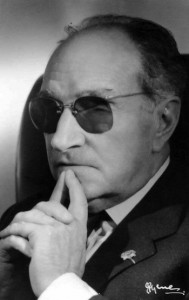 Joachín Rodrigo was born in Sagunto, Valencia on the Mediterranean coast of Spain in 1901. He was the youngest of ten children born to Vicente Rodrigo, a landowner. At the age of three, diphtheria left him almost completely blind. His parents sent him to a school for blind children. There, he learned Braille and eventually wrote all his compositions in that form, which were subsequently translated for publication. His early musical career coincided with the outbreak of the Spanish Civil War in his homeland. He continued his musical education in Paris. He married Victoria Kami, a Turkish-born concert pianist. Rodrigo and his wife were received as Spanish refugees in Freiburg, Germany. There, they gave lessons in Spanish and music in their room at the Institute for the Blind. Nonetheless, the couple was persecuted because of the fact that Victoria was Jewish. They found safe conduct out of Germany and into Switzerland.
Tragedy struck when Victoria suffered the miscarriage of their first child. The loss deeply affected Rodrigo. Later in life he and his wife informed the world that the Concierto was written as a response their child’s premature death. The couple returned to Spain on September 1st 1939, two days before the outbreak of the Second World War, carrying with them the manuscript of the Concierto de Aranjuez in a suitcase.
Rodrigo suffered disability, expatriation, and persecution. He witnessed the ravaging of Europe, the plundering of his own country, and the loss of his first child. Yet he persevered, never lost hope, and came to personify what Edna St. Vincent Millay said about another composer—Ludwig van Beethoven—as “the tranquil blossom on the tortured stem”. He transcended adversity and left the world a great musical legacy. His music cannot be separated from his life. It remains, as does all great music, the expression of a great soul.
In his later years, Rodrigo was showered with honors and tributes. In 1991 he received the Guerrero Foundation Prize and was raised to the nobility by King Juan Carlos I with the title, “Marqués de los Jardines Aranjuez”. In 1996 he received another great honor, being awarded the Prince of Asturias Prize “for his extraordinary contribution to Spanish music, to which he gave a new and universal dimension”.
Joaquín Rodrigo died in Madrid in 1999, his life spanning nearly an entire century. His daughter, Cecilia, succeeded him as Marquésa de los Jardines de Aranjuez.. He and his wife are buried in the cemetery at Aranjuez.
 Dr. Donald DeMarco is a Senior Fellow of Human Life International. He is professor emeritus at St. Jerome’s University in Waterloo, Ontario, an adjunct professor at Holy Apostles College in Cromwell, CT, and a regular columnist for St. Austin Review. His latest works, How to Remain Sane in a World That is Going Mad and Poetry That Enters the Mind and Warms the Heart are available through Amazon.com.
Articles by Don:


