


Why would anyone seek admission to a university, pay tuition, purchase books, and then not attend class, take tests, or study? Why would anyone buy a home, furnish it, and then leave it vacant and neither rent it nor live in it? Why would anyone go to a physician, seek a medical cure, and then ignore the prescription and disregard the doctor’s orders? Many people who desire love and marriage pursue their goal in a manner that resembles the student, the home buyer and the patient in the above examples. They fail to see the end, the final cause, or the ultimate purpose for the action and ignore the logical relationship between the means and the end. They miss the self-evident truth that marriage is ordered toward procreation just as man and woman are designed for marriage.
If men and women seek marriage but deliberately avoid or reject children through sterilization, contraception or abortion, they do not choose marriage for the great purpose Nature and God intended it to fulfill: “Be fruitful and multiply”. To desire marriage, but not the children that issue from the bond of union, frustrates the natural purpose of this relationship. Even though marriage overcomes loneliness and brings many blessings to man and woman besides children, the language of the body and the nature of man and woman seek expression and fulfillment in the life-giving love of mutual giving and receiving between husband and wife in the spirit of self-donation and surrender. While older couples or the widowed who marry past the fertile years have no specific intention to bear children but enjoy other blessings of marriage, they do not deliberately marry with the motive of childlessness that informs the contraceptive mentality.
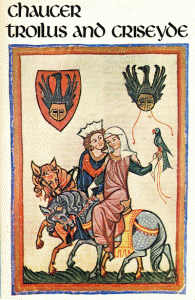 This divorce of fertility from marriage and the separation of love from marriage and children identifies the ancient heresy of courtly love that prevailed in the fourteenth century—a heresy of the Middle Ages that attacked the Church’s teaching on the nature and purpose of matrimony. The cult of courtly love, satirized in many stories from Chaucer’s The Canterbury Tales and explained at length in C. S. Lewis’s The Allegory of Love, idealized the intrigue of adulterous love as more romantic and enticing than prosaic marital love in its humdrum familiarity. Courtly lovers who conducted these clandestine affairs with consummate artfulness relished the keen anticipation and heightened pleasure of their forbidden rendezvous. Troubadours who sang the bliss of courtly love in their performances at courts popularized the idea and gave it the image of respectability–the love practiced by the elite nobility and the cultured members of the court. The heresy of courtly love eliminated romance from marriage and identified the rapture of love with extra-marital intrigues safeguarded with the utmost secrecy. Highly ritualized with many rules of conduct for the initiated, courtly love assumed the obligation of concealment and appropriated the word “honor” to mean protecting the woman’s reputation from scandal and gossip. As Lewis writes, “[t]his erotic religion arises as a rival or a parody of the real religion and emphasizes the antagonism of the two ideals.”
The troubadours and poets glamorized courtly love. The deadly sin of lust was elevated to the status of idealized erotic passion that marriage with its many cares and responsibilities to children did not allow. Because it was practiced by the well-bred, refined, and noble like Sir Lancelot and Queen Guinevere from King Arthur’s Camelot, courtly love was distinguished not only from the commonness of marital love but also from the cheapness of prostitution. Endorsed by knights, ladies, the educated, and the poets, courtly love acquired an aura of glamorization, an appearance of pure, exalted love that gave it fascination and rescued it from the subservient quality of married love and the humble duties of parenthood. In short, courtly love separated romance from both marriage and children—the two conditions that deprived love of its poetry and allure. Like all heresies that disappear and then return with a new name and a more updated image, the heresy of courtly love assumes a fresh appearance nowadays with a widespread popularity and influence as childless marriages, cohabitating relationships, contraceptive habits, and legalized abortions gain the status of progressive, enlightened, liberated, and advanced thought hailed by its apologists.
However, as Chaucer shows in his satire of courtly love in Troilus and Criseyde, two lovers can speak rhapsodically about the bliss of love, the greatness of their passion, and their undying commitment to each other. Troilus rejoices, “For was there ever man had such a measure/ Of joy as I, on whom the loveliest/ I ever saw has deigned her heart to rest.” While they praise Venus, the goddess of love, Troilus and Criseyde never allude to marriage or children in the entire course of their secretive, illicit romance which they guard from public knowledge. Their love story that exalted the beauty of their romance as ecstatic happiness falls from high to low when they experience a turn of the wheel of fortune that separates the lovers. Because they have not pledged marriage, promised the fidelity of spouses to one another, or considered the relationship of love to marriage and children, their courtly love amounts to nothing except Troilus’s broken heart, Criseyde’s new lover, and the lie of courtly love collapsing in the midst of the exigencies of the hard realities of daily life.
Likewise, modern relationships that resemble the medieval cult of courtly love have the same trajectory of great idealistic expectations descending into tragic sufferings. Without marital vows till “death do us part” and the promise of fidelity, the fickleness of Fortune’s wheel inevitably leads from the heights of bliss to sudden disillusionment and abject misery. Cohabitation cannot last or grow as a happy relationship of love. Love without the desire for children leaves an empty, unfulfilled heart as the natural fruitfulness of love never produces the harvest of the family. The contraception that rejects the fruits of love and the aborting of new life contradict the nature of love as sharing, giving, and sacrificing with abundant generosity. The attempt of cohabitation to divorce love from marriage or the aim of contraception to eliminate children from marriage also has its special troubadours in the form of the propaganda of the media who rename these practices with euphemisms. The cult of medieval courtly love has transformed into freedom of choice, the quest for reproductive rights, the glamour of career and quality of life, zero population growth, sexual liberation, and the worship of pleasure.
Modern man does want the cornucopia that Nature and God offer. He sows but does not want to reap the blessing of children. He seeks but does not want to find love in its fullness. He works but does not want to see the finished beauty of his handiwork. He seeks intimate relationships but frustrates their oneness. The cult of courtly love has mutated to the religion of lifeless love.
 Mitchell Kalpakgian, Ph.D. has completed fifty years of teaching beginning as a teaching assistant at the University of Kansas, continuing as a professor of English at Simpson College in Iowa for thirty-one years, and recently teaching part-time at various schools and college in New Hampshire. As well as contributing to a number of publications, he has published seven books: The Marvelous in Fielding’s Novels, The Mysteries of Life in Children’s Literature, The Lost Arts of Modern Civilization, An Armenian Family Reunion (a collection of short stories), Modern Manners: The Poetry of Conduct and The Virtue of Civility, and The Virtues We Need Again. He has designed homeschooling literature courses for Seton Home School, and he also teaches online courses for Queen of Heaven Academy and part-time for Northeast Catholic College.


