


It is said that the pen is mightier than the sword, but when the pen is wielded with the purpose of disemboweling an opponent the only difference from the sword becomes how much of a mess is left to clean up. In the current culture wars words are truly weapons; they fly fast and furious and often have little purpose aside from psychological evisceration.
Dr. Donald DeMarco’s article on the use of the word “bigot” in the territorial brawl for marriage encapsulates this perfectly. “Bigot” is twisted from its original meaning (one who regards or treats members of a group with hatred or intolerance) to now mean any person who claims certain acts to be immoral or tells someone else they are not allowed to do something they want.
It should not come as a surprise that words can be misused so easily. The English language is known for its propensity to offer a variety of utterances to convey a single concept. For instance, if the word “naïve” doesn’t suit your mood, you have only to choose from the following: dewy, green, ingenuous, innocent, primitive, simple, unsophisticated, unsuspecting, and unworldly (I omitted half of the synonyms offered by Merriam-Webster to avoid more redundancy). Choosing words now has all of the deliberation of picking out shampoo at Target: the choice is based more on the attractive packaging than the efficacy of its contents.
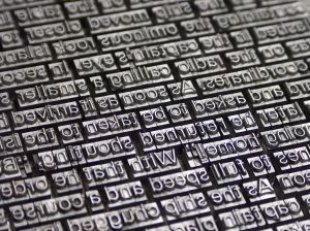 While variety is nice in certain respects, when it comes to words, it behooves us to remember the natural purpose of words. Words are the encapsulation of concepts. The union of concept and letter groupings can be compared to the relationship between the human body and soul. The body gives the soul a material reality, and the soul gives the body its form. Not all words are equal of course. The word “hello” could be classified as an unimportant word conceptually if taken per se. The word “happy,” on the other hand, is in itself a word that carries a much more substantial concept. The importance here lies in the fact that until the Enlightenment, concepts and the words they embody were assumed to be as inseparable as the human body and soul.
The word was chosen, or made, specifically to fit the concept. The concept gave the word life, and ruled over it. This is no longer the case, and its effect is at the heart of the culture war. Words such as “marriage,” “fetus,” “human being,” “good,” “truth,” “right,” “wrong,” and “happy” are at the heart of the discord, and there is no avenue of human experience that remains free from the verbal abuse.
Thus far, secular society has been dominating the use of words in the culture war. The discourse remains focused on hulling the concept out of the word and creating new concepts to refill the words. For this very reason secularists are able to hold dominion over the debates.
To balance the terms of engagement, faithful apologists of all walks need to remember the ancient argument over the “one iota.” The reintroduction of “consubstantial” into Catholic liturgy, as Stephen Colbert pointed out recently, is not user-friendly. However whether he meant it or not, Mr. Colbert made a point that all should take note: “consubstantial” is not intended for ease of speech, but rather to convey a concept of profound importance. The emphasis of using such a word, or any word, should be concept oriented, not letter group oriented. To focus on the latter is a matter of gratuitous rhetoric.
Returning to the modern culture war, the discord could now be delineated by the focus on concept primacy versus word primacy. From the viewpoint of those who support a “right to abortion”, the subject of termination is almost always a “fetus”, not a “baby.” Both can be used interchangeably without inaccuracy, but in light of determining and protecting the entities right to life at any point, the word chosen makes all the difference.
In choosing the word “fetus,” the subject to be terminated is stripped of any recognizable humanity. This allows the argument to be made that yes, a fetus is a creation of genetic material that is the same as the person sitting next to you, but it is not really a person. It cannot do what a real human can, and therefore should not be afforded the same rights. To use the word “baby” on the other hand carries the connotation of a human person two whom other people feel a connection. The use of “baby” is concept oriented toward the larger community of humanity, whereas “fetus” is segregated and creates distance between the human community and what is, in fact, a human being.
In the debate concerning what defines a marriage comes what, for many, will be the most difficult obstacle to overcome: the constancy of a concept. This is so because the Enlightenment virtually destroyed the concept of a “universal” – that which is present or occurring everywhere. In its place, individualism became king, and it is not hard to see the fruits of that mode of thinking today; the attempt to redefine marriage is just one of many victims of Nominalist thinking.
For those of us who uphold and defend “traditional” values it is time to seriously reexamine our words and use them with the wisdom that the ancient Fathers did: to convey the concepts that govern our life, in particular the concept of universality. Words have meaning and words have implications for life, faith and family.
 Melissa Maleski is a graduate student at the Notre Dame Graduate School of Christendom College. As a result of some lively debates in college and the desire to learn Latin, Melissa entered the Catholic Church in 2003. She is the proud spouse of a military serviceman, and her time is filled with the adventures of three small children. Melissa and her family are joyfully awaiting the arrival of baby number four. Melissa serves as a volunteer catechist at various parishes. Any free time she has is devoted to reading, cooking, and running. After graduation Melissa is looking forward to pursuing her studies in the disciplines of Church history and marriage and family issues.


