


Father James V. Schall S.J., a professor of political philosophy at Georgetown University, recently gave his “Last Lecture,” entitled “The Final Gladness .” One of its main themes is one which Father Schall has consistently used throughout his writings, namely that politics has limits. As President Barack Obama is sworn in for his second term as the president of our nation, it seems fitting to focus on this same theme.
In his book Beyond Politics, the English Historian Christopher Dawson writes,
We have no right to expect that Christian principles will work in practice in the simple way that a political system may work. The Christian order is a supernatural order. It has its own principles and its own laws which are not those of the visible world.
Dawson highlights the limits of politics because the laws that politicians pass and choose to uphold can have consequences beyond this world. Regardless of one’s political affiliation, it seems politicians on both sides of the aisle have forgotten about these limitations.
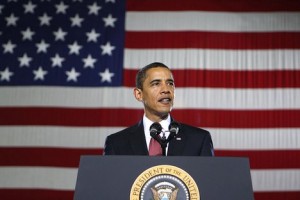
Photo by Gage Skidmore
When a person has embraced a materialist outlook, it is only natural for him to propose solutions as if this world were the final reality. There are many Christians that have become what Blessed Pope John II referred to as “practical atheists.” These people may attend Church services regularly or occasionally, but they live as if God did not exist. In the end, their lives are barely distinguishable from that of self-professed atheist Susan Jacoby, who asserts that, “The atheist is free to concentrate on the fate of this world” (emphasis added). During this Year of Faith, we need to remind our brothers and sisters in Christ that we are “strangers and sojourners” in this world (Ephesians 2:19). That is, this world is not our final destination.
Christians need to quit placing all of their trust in politicians simply because of their party affiliation. We can begin this correction by regaining a proper perspective that the early Christians had in relation to their surrounding culture. A letter written in the 2nd or 3rd century, The Epistle to Diognetus, provides the faithful with the needed reality check:
Christians are not distinguished from the rest of humanity by country, language, or custom. For nowhere do they live in cities of their own, nor do they speak some unusual dialect, nor do they practice an eccentric way of life … They live in their own countries, but only as nonresidents; they participate in everything as citizens, and endure everything as foreigners. Every foreign country is their fatherland, and every fatherland is foreign. They marry like everyone else, and have children, but they do not expose [kill] their offspring. They share their food but not their wives. They are in the flesh, but they do not live according to the flesh. They live on earth, but their citizenship is in heaven. They obey the established laws; indeed in their private lives they transcend the laws. They love everyone, and by everyone they are persecuted.
Even if it is clear that Christians have forgotten their true patrimony is found in the Kingdom of God, this does not mean that we should shun or disdain the world. We are called to transform and renew it by our prayer and saintly lives. We need to be reminded that we are in the world, but not of it (cf John 17:14-16). It is because this world is not our final resting place that Christians will find that their lives are always counter cultural, particularly when it comes to the issues relating to morality.
Throughout history, politicians seem to forget the eternal truth that there is much more to life than this world has to offer. The primary concern of politics should be justice, in particular it should be concerned with protecting citizens’ authentic human rights, as well as with protecting the basic institutions that foster virtue and healthy societies: the natural family and religion.
There seems to be great confusion because many in politics are concerned with charity, while many in the Church are primarily concerned with political justice. Roles have become reversed. Politics should be directed toward maintaining the natural order, while the Church’s primary focus should be the supernatural order.
Our nation should never be seen as a “city on a hill.” For Christians, the city of God transcends this world. We are called to work for a civilization of love, but we must come to sober realization that this will not be fully completed within the course of human history.
There is an authority to Whom all men and women owe the obedience of love – Almighty God Himself. The Father has fully revealed Himself to us in His Son and He continues to carry out His sanctifying work through the power of the Holy Spirit. The Spirit of God needs men and women to serve as instruments that work to transform this world through works of charity and through lives of virtue as a reminder to the people around us that our ultimate home is to be found only in communion with God.
In his Letter From a Birmingham Jail, Martin Luther King Jr., whose life and legacy we remember on this day, recognizes the limits of politics in relation to the formulation of law:
A just law is a man-made code that squares with the moral law or the law of God. An unjust law is a code that is out of harmony with the moral law. To put it in the terms of St. Thomas Aquinas: An unjust law is a human law that is not rooted in eternal law and natural law. Any law that that uplifts human personality is just. Any law that degrades human personality is unjust.
We continue to allow politics to transgress its limits in violation of the eternal law at the expense of innocent human life, religious liberty, and the sanctity of marriage.
Tomorrow’s 40th anniversary of Roe v. Wade underscores how far we have allowed politics to go beyond its just limits, and how this not only degrades human dignity, but destroys countless human lives. Let us pray on this inauguration day that President Obama and all of our fellow citizens will come to the knowledge that our ultimate destination – the “final gladness” – will not be found in this life. When more people come to this realization we may finally see the need to direct the natural order with the supernatural order of our Heavenly Father.
 Roland Millare is the chair of the Theology Department at Saint John XXIII College Preparatory in Katy, TX. He also serves as the Director of Middle School CCE at St. Theresa Catholic Church in Sugar Land, TX and an adjunct professor of theology for Deacon candidates at St. Mary’s Seminary in Houston, TX. He has a BA in Theology from Franciscan University in Steubenville, OH, a MA in Theological Studies from the Notre Dame Graduate School of Christendom College in Alexandria, VA, and a Licentiate in Sacred Theology (STL) from the Liturgical Institute of the University of St. Mary of the Lake in Mundelein, IL. Roland is a member of the Fellowship of Catholic Scholars, and an advisory board member to the Pope John Paul II Forum. Currently, he is a candidate for a Doctorate of Sacred Theology (STD). He lives with his beautiful wife Veronica and their baby girl Gabriella in Sugar Land.


