


Germane to a discussion on conscience is John F. Kennedy, who, as a politician, ironically promoted an arguably anti-Catholic mentality in several of his views on the moral conscience and the role of religion in the public square.
Kennedy has, of course, subsequently become a prototype for others who have followed his style of Catholicism with regards to public life. His principles on this subject were mainly espoused in a presidential campaign speech to a group of Protestant pastors at the Greater Houston Ministerial Association in 1960 while he was still a senator. Although much could be written both pro and con, about this “Speech on Faith” or “Ministerial Association Speech,” here the discussion is limited to merely addressing two false dichotomies.
In speaking before a group of Protestant ministers with regards to being a member of the Roman Catholic Church, especially in 1960, it is somewhat understandable that JFK declared the following: “For contrary to common newspaper usage, I am not the Catholic candidate for president. I am the Democratic Party’s candidate for president, who happens also to be a Catholic. I do not speak for my church on public matters, and the church does not speak for me.” He says that he happens to be Catholic because he and forty million other Americans (the number he quotes three paragraphs later) were baptized Catholic.
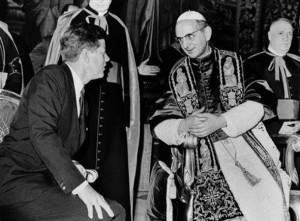
John F. Kennedy and Pope Paul VI
On one level, by quoting the substantial number of Catholics in the United States he is highlighting the importance that he is one among a significant demographic and therefore should be respected as such.
On a deeper level, however, he is intimating that he is part of a phenomenon known as “cultural Catholicism” wherein an individual is Catholic because he or she is born into and raised in a family of, for example, Irish, Italian or Hispanic descent. The implication is that an individual as an adult has not yet necessarily fully chosen to be Catholic which would mean to maturely accept the moral consequences and intellectual theological tradition inherent within Catholic Christianity.
So, it is fitting that the future 35th President of the United States make the admission and declare that he is simply a particular party’s candidate and not a Catholic candidate for the presidency.
Kennedy is further correct in saying that the Church does not speak for him on public matters regarding moral issues because his view of the Church, while perhaps sincere, is off base. Indeed, it is possible to be convinced of possessing a mature faith and its understanding, while in reality the opposite may be the case.
Thus, JFK argues the following with regards to his understanding of the conscience:
Whatever issue may come before me as president – on birth control, divorce, censorship, gambling or any other subject – I will make my decision in accordance with these views, in accordance with what my conscience tells me to be the national interest, and without regard to outside religious pressures or dictates. And no power or threat of punishment could cause me to decide otherwise. But if the time should ever come – and I do not concede any conflict to be even remotely possible – when my office would require me to either violate my conscience or violate the national interest, then I would resign the office; and I hope any conscientious public servant would do the same.
By “these views” mentioned in the first sentence of the quotation above, he is referring to his understanding of the authority of the Church as being non-binding upon Catholic politicians and concomitantly the absolute separation of Church and State as he put forward earlier in preceding paragraphs of this “Ministerial Association Speech.” If he were formulating the above first paragraph today, the first part of the first sentence above would read: “Whatever issue may come before me as president – abortion, same-sex ‘marriage,’ the manipulation and destruction of human embryos for ‘research,’ etc.”
Of course, there is little doubt that the second part of the first sentence would still declare: “I will make my decision in accordance with these views, in accordance with what my conscience tells me to be the national interest, and without regard to outside religious pressures or dictates” – in other words, he would have no problem with promoting them all (like his late brother Ted Kennedy known as the “liberal lion of the Senate” made it a point to do and his daughter Caroline who recently spoke passionately in favor of abortion at the Democratic National Convention) with no regard for Church teaching, the Bishops, nor to the “pressures” of denial of the Eucharist or even excommunication. Again, as he says: “I do not speak for my church on public matters, and the church does not speak for me.”
In this light, it is here that I draw attention to how Senator Kennedy sets up a false dichotomy between his “conscience” and the “national interest” on the one hand and “outside religious pressures or dictates” on the other. It should be noted that the “national interest” does not always equate with the “common good” or with what is right and just.
“National interest,” in the way that JFK uses it, is code for what the majority of voters want – what may even be the very vocal but small minority – whom he as a politician is apt to please in order to garner votes and be elected. Of course, what the national majority wants might not always correspond with the supra-national good or the “common good” (for example, take abortion – it is not in children’s favor to be defenselessly murdered, but it might be said to be in the “national interest” and therefore of interest to the one who wishes to be elected).
Senator Kennedy considers his own conscience to be infallible and compares the national interest with what is right and therefore to be adhered to (not that the national interest is unimportant or always misplaced). In this way, he tries to denominate faith and religion as impositions on his conscience as well as the national interest, and therein lies the false dichotomy.
By forming this categorization, he (or his speechwriter) fails to make important distinctions which would connect a well-formed conscience with adherence to the tenets of the Faith, the natural law and the Magisterium of the Church on matters of morals (which truly do affect and effect the national as well as the individual’s good).
 Fr. Gerald Goodrum, S.T.L. is a priest of the Archdiocese of Galveston-Houston. He holds a Licentiate in Philosophy from the Catholic University of America (Washington, DC) and a Licentiate in Sacred Theology from the Pontifical Gregorian University (Rome), where he is currently a doctoral student. The article above has been adapted from his recently published book American Politics and Catholic Christianity: Issues of Conscience and Defined Moral Doctrine (available from amazon.com in both English and Spanish).


