


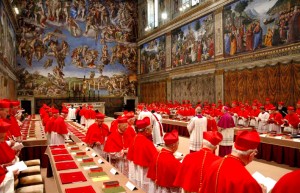
Frank Bruni, in a recent New York Times piece (Feb. 24, 2013) describes the election of the new pope as a “pageant extraordinaire” that can be compared with the excitement that the Academy Awards generates or the thrill of a horse race. Concerning its relevance for Catholics, however, it is dubious. It hardly matters, Bruni contends, who will be the next pontiff to occupy the Chair of Peter since Catholics “have minds and wills of their own” and no conclave will ever change that.
For Bruni, the Red Sea has parted, leaving an unbridgeable chasm between an irrelevant, but fascinatingly ceremonial Church on the one hand, and Catholics who can think for themselves, on the other. American Catholics now show “a robust disobedience” and are “less attached to [the Church’s] tradition”.
 It is true, of course, that each one of us has a mind and a will of our own. No one contests this. It is not an issue. There is little advantage in pointing it out. It is self-evident. What we need to know is how to use our mind and how to use our will. This is exactly where the Church is not only relevant, but of great service.
St. Thomas Aquinas put the matter quite plainly when he said, “Three things are necessary for the salvation of man: to know what he ought to believe, to know what he ought to desire, and to know what he ought to do.”
The mere possession of a faculty does not insure its proper use. One may drive a new Cadillac directly into a tree. If one owns a car, he is well-advised to learn how to drive it. The Catholic Church, having been founded on Love, wants to help people to know what is true and to choose what is good. She understands only too well that a faculty, such as a mind or a will, can be detrimental to the person if it is used improperly. Thus, the Church is an educator inasmuch as she directs the mind and the will to their proper and fulfilling objects. She is like a doctor who tells a patient that eating nourishing food is consonant with the needs of the digestive system. It makes little sense for the patient to retort, “Get off my back, I have a digestive system of my own”!
Pride is our great nemesis. We often think that we are self-sufficient, self-reliant, and self-trustworthy. The incontestable fact is that we are not. A brief look at history should be sufficiently instructive. A glance at personal tragedies is also most useful.
When actor William Holden was involved with Grace Kelly, the suggestion was raised that if he became a Catholic, his marriage to actress Brenda Marshall could be annulled thereby clearing the path for him to marry Grace. In response to this suggestion, Holden said, “I’d be damned if I’d let any church dictate what I could do with my life.”
A swimming coach instructs a neophyte on how to swim. The student does not recoil and exclaim, “I do not need anybody to dictate to me how to swim!” The need that human beings have for enlightenment about how they should live is glaringly evident.
Robert Lacey, in his biography of Grace Kelly, simply titled, Grace, writes the following about Holden’s demise: “William Holden was to die a broken and embarrassing alcoholic, literally too drunk to save his own life when he fell and cut his head open [in a motel] at the age of sixty-three.” Holden had been in intensive therapy for four years prior to his death. His therapist, Michael Klassman, asserted that it was Holden’s wish that the world should know the details of the actor’s alcoholism.
We all need help. People do not hesitate to seek the assistance of psychiatrists, lonely hearts columnists, gurus of various types, astrologers, psychics, celebrities, bartenders, and the various authors of innumerable self-help books. Their attitude in these cases is docile, respectful, and hopeful. It is anything but one of “robust disobedience” or deep suspicion. Frank Bruni seems to think that we prove that we have minds and wills of our own only when we misuse them. Adam did not prove he had a mind and will of his own; he proved that the consequences of their misuse can be catastrophic.
St. Augustine noted that religion demands three qualities above all others: humility, humility, and humility. We need humility to recognize that we are not self-sufficient. We need humility to recognize that Catholic teaching is trustworthy and salutary. Finally, we need the humility to live with humility, that is, to be grateful for the help that is available to us that does not originate in ourselves. We cannot raise ourselves up by our own bootstraps.
Catholics have minds and wills of their own. But this merely describes the starting point, not the finish line. The long journey to God and toward personal fulfillment requires conforming our minds to truth and our wills to what is good. Our attitude toward the Church should be, more than anything else, one of gratitude rather than criticism.
 Dr. Donald DeMarco is a Senior Fellow of Human Life International. Doctor DeMarco is a member of the Pontifical Academy for Life and he is Professor Emeritus at St. Jerome’s University in Waterloo, Ontario and an adjunct professor at Holy Apostles College & Seminary in Cromwell, CT.
He is the author of 22 books, including; Architects of the Culture of Death, The Many Faces of Virtue, The Heart of Virtue, and New Perspectives on Contraception. He has authored several hundred articles in scholarly journals and in anthologies, and articles and essays appearing in other journals and magazines and in newspapers; and innumerable book reviews in a variety of publications.
His education includes: B.S. Stonehill College, North Easton, MA 1959 (General Science); A.B. Stonehill College, 1961 (Philosophy); Gregorian University, Rome, Italy, 1961-2 (Theology); M.A. St. John’s University, Jamaica, NY, 1965 (Philosophy); and Ph.D. At. John’s Univ., 1969 (Philosophy). His Master’s dissertation was “The Basic Concept in Hegel’s Dialectical Method” and his Doctor’s dissertation was “The Nature of the Relationship between the Mathematical and the Beautiful in Music”.
He is married to Mary Arendt DeMarco and they have five children.
 Print
Print  PDF
PDF 