


The first Christmas was not an event that was met with universal acceptance. Upon arriving in Jerusalem, the Magi asked, “Where is he that is born king of the Jews?” Not knowing the political situation in that city, their question was as naïve as it was dangerous. King Herod could not abide there being any other king of the Jews than himself. He had also believed that the Messiah would be born in Bethlehem, being acquainted with a passage in Micheas (5:1-2) that read: “And thou, Bethlehem Ephrata, though thou art little among the thousands of Juda, out of thee shall come forth for me (one who shall be) ruler of Israel.”
In a diabolical plan to secure his throne, Herod asked the Magi to report to him when they found the child. When they failed to do so, he commanded his henchmen to kill all male children in Bethlehem and the surrounding area that were younger than two years of age. Scholars have estimated, using demographic factors, including infant mortality rates that between 20 and 25 male infants were killed.
Herod did not succeed, however, in executing the Messiah. Joseph was told in a dream what he must do to avoid Herod’s murderous plan: “Rise up, take with thee the Child and His mother, and flee to Egypt; There remain, until I give thee word, for Herod will soon be making search for the child, to destroy Him (Matthew 2:13).”
Today, the Catholic Church celebrates the Feast of the Holy Innocents with joy commingled with sadness. She rejoices that these little ones are with God in heaven; she mourns with the disconsolate mothers who cannot witness their children’s happiness. Accordingly, in the words of Jeremiah (31:15): “A voice is heard in Rama, cries and lamentations unceasing: It is Rachel weeping for her children; she is inconsolable, because they are no more.”
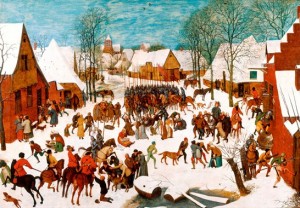
Massacre of the Innocents, Pieter Bruegel the Elder (1565-67)
The Massacre of the Innocents has been the subject of a number of paintings. Perhaps the best known is that of Pieter Bruegel, whose 1567 work depicts the event in an isolated hamlet in Flanders and shows mothers grieving over their slaughtered children. It is as if the artist were saying: “This horrific event could happen again and it could happen anywhere.” Bruegel was always trying to bring the Gospel message into his own time and place.
Obviously, no painting or sermon is needed to remind people of the slaughter of innocent children. The recent slaughter of 20 children and 6 adults in Newtown, Connecticut has been graphically imposed on the hearts and minds of people throughout the world. Good art always parallels life. Dean Koontz’s novel, Odd Thomas is about a 20-year-old ordinary man who possesses the extraordinary ability to commune with the dead, including those who are young and suffered violent deaths:
Odd Thomas has some advice for us: “We who survive must go on in the names of those who fall, but if we dwell too much on the vivid details of what we’ve witnessed of man’s inhumanity to man, we simply can’t go on. Perseverance is impossible if we don’t permit ourselves to hope.” This book, published in 2003, was well received and applauded by critics, and became a New York Times best-seller. Its message of hope is welcomed and needed.
Hope and love are words that have been often repeated in recent days. The two are inseparable. One cannot love without hope. One important lesson that Newtown has reaffirmed is the strength and the primacy of love. It is love for life that is real and powerful, seemingly, at times, too powerful to bear. Evil, by contrast, is unreal and incomprehensible. One cannot lose a child and remain skeptical about love. One has experienced it to the depths. Love is overwhelming. Life is the most precious thing we have.
Although children of 6 or 7 years of age are not typically innocent in the strict sense of the term, they are most certainly children. As Christ has told us, there is something sacred and holy about children. “Amen I say to you, unless you turn and become like little children, you will not enter into the kingdom of heaven.” The prerequisite of gaining heaven, then, is childlikeness! But what is this quality if it is not innocence?
The highly respected theologian, Monsignor Romano Guardini gave much thought to this question. He speaks of childlikeness as “unruffled trust.” He speaks of “the child’s clarity of vision; the ability to look up and out, to feel and accept reality without ulterior motives.” This childlike quality is precisely that which is suggested by the term “believer.” We must continue to believe, despite everything.
It is easy for a child to be childlike, to easily believe in the supernatural and live by an abiding trust in mom and dad. How difficult it is for an adult to regain the quality of childlikeness. In the aftermath of a tragedy like the one in Newtown, how do the grieving parents regain trust in God, in life, in love, and learn to hope all over again? They need the patience of Job, and the faith that moves mountains.
“A penny for your thoughts,” one might request. And there, over the image of Abraham Lincoln, are the words that some misguided souls have sought to erase: “In God we trust.” That trust is what cannot be lost. Love is more powerful than violence. Let us pray that the violence that came to Newtown will not conquer the human soul’s ability to continue to trust in God.
 Dr. Donald DeMarco is a Senior Fellow of Human Life International. Doctor DeMarco is a member of the Pontifical Academy for Life and he is Professor Emeritus at St. Jerome’s University in Waterloo, Ontario and an adjunct professor at Holy Apostles College & Seminary in Cromwell, CT.
He is the author of 22 books, including; Architects of the Culture of Death, The Many Faces of Virtue, The Heart of Virtue, and New Perspectives on Contraception. He has authored several hundred articles in scholarly journals and in anthologies, and articles and essays appearing in other journals and magazines and in newspapers; and innumerable book reviews in a variety of publications.
His education includes: B.S. Stonehill College, North Easton, MA 1959 (General Science); A.B. Stonehill College, 1961 (Philosophy); Gregorian University, Rome, Italy, 1961-2 (Theology); M.A. St. John’s University, Jamaica, NY, 1965 (Philosophy); and Ph.D. At. John’s Univ., 1969 (Philosophy). His Master’s dissertation was “The Basic Concept in Hegel’s Dialectical Method” and his Doctor’s dissertation was “The Nature of the Relationship between the Mathematical and the Beautiful in Music”.
He is married to Mary Arendt DeMarco and they have five children.
 Print
Print  PDF
PDF 