


Like thousands of others, the last few Sunday evenings have found me settling in to my couch and tuning in to watch Downton Abbey. This PBS series set in early twentieth century England chronicles the drama, trials and tribulations of the residents of Downton Abbey, the ancestral home of the aristocratic Crawley family.
The current season finds the characters confronting the social changes of the 1920s. The family patriarch is struggling to preserve his position in society and the younger generation is testing the limits of a more relaxed social morality. Distinctions between British peerage and the commoners are beginning to blur.
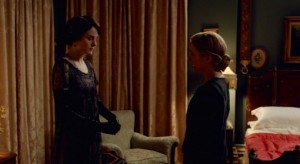 Lady Mary, the eldest Crawley daughters, decides to spend a week in the intimate company of one of her suitors in order to see if he is truly the right man for her to marry. In the process of arranging this secret rendezvous, the storyline touches on the changing attitudes towards contraception.
The year is 1924 and Mary, as a single woman, cannot obtain contraception from the local apothecary. She sends her maid Anna, a married woman, to purchase some sort of contraceptive device for her. She gives Anna a book by Marie Stopes, marking the page containing information about her contraceptive “needs”. Even though Anna is married, she feels ashamed to buy birth control and the shop clerk clearly finds the use of contraception of questionable propriety. It is only after Anna tells her that she is avoiding pregnancy for health reasons that the clerk relaxes her judgment of Anna and cooperates with the purchase.
As I watch this story unfold and with the benefit of knowing what ensues in the next ninety years, I find myself wanting to grab Lady Mary by the shoulders and scream, “Please, no! You are on the road to heartache. Abandoning chastity will not strengthen your eventual marriage. Contraception and eugenics advocate Marie Stopes is a false prophet!” Unfortunately, I cannot change history.
This vignette from Downton Abbey offers a small window into the changing societal attitudes towards sex and contraception in the Roaring Twenties. While many today point to the 1960s as the era of sexual revolution, it is clear that the devolution of sexual mores began decades earlier. In fact, a mere six years after Anna’s humiliating experience in the apothecary, she would be able to waltz in to the shop and openly purchase contraception with the full backing of the Church of England. In 1930, the Anglican Communion became the first mainline religious sect to endorse contraception and declare the use of contraception within marriage to be morally acceptable.
In response to this momentous shift, Pope Pius XI wrote his profound encyclical, Casti Connubii, affirming the central role of procreation in marital relations. He minced no words in condemning the acceptance of contraception within marriage:
Since, therefore, openly departing from the uninterrupted Christian tradition some recently have judged it possible solemnly to declare another doctrine regarding this question, the Catholic Church, to whom God has entrusted the defense of the integrity and purity of morals, standing erect in the midst of the moral ruin which surrounds her, in order that she may preserve the chastity of the nuptial union from being defiled by this foul stain, raises her voice in token of her divine ambassadorship and through Our mouth proclaims anew: any use whatsoever of matrimony exercised in such a way that the act is deliberately frustrated in its natural power to generate life is an offense against the law of God and of nature, and those who indulge in such are branded with the guilt of a grave sin (56).
I first read Pope Paul VI’s 1968 encyclical Humanae Vitae thirty years after it was written. I was astounded at the time by its wisdom and its prescience as the Holy Father warned contraception posed a grave threat to the institution of marriage and to families. When I read it, I had no idea that forty years before Pope Paul VI promulgated Humanae Vitae, Pope Pius XI had already thoroughly addressed the issues of sex, marriage, contraception and the sanctity of human life in Casti Connubii. He even warned against a radical feminism that urges women to forsake their roles as wives and mothers in order to pursue worldly material success:
This, however, is not the true emancipation of woman, nor that rational and exalted liberty which belongs to the noble office of a Christian woman and wife; it is rather the debasing of the womanly character and the dignity of motherhood, and indeed of the whole family, as a result of which the husband suffers the loss of his wife, the children of their mother, and the home and the whole family of an ever watchful guardian (75).
Yet this document is much more than stern words and prohibitions. Pope Pius XI writes of the true nature of marriage with immense compassion, love and poetic beauty:
By matrimony, therefore, the souls of the contracting parties are joined and knit together more directly and more intimately than are their bodies, and that not by any passing affection of sense of spirit, but by a deliberate and firm act of the will; and from this union of souls by God’s decree, a sacred and inviolable bond arises.
The contemporaries of Lady Mary thought they were so enlightened they could discard the sexual morality and teachings of the Church. They were no different than the generations that preceded them or the generations that followed, including our current one. Yet over and over again, history proves the rightness and wisdom of the Church’s unwavering commitment to marriage as a Divine institution grounded in Natural Law. I would love to see Casti Connubii receive more attention and become a standard part of all marriage preparation programs. The language of Casti Connubii may seem dated to current readers but the ideas and principles are timeless.
 Dr. Denise Jackson Hunnell is a Fellow of Human Life International. She graduated from Rice University with a BA in biochemistry and psychology. She earned her medical degree from The University of Texas Southwestern Medical School. She went on to complete a residency in family medicine at Marquette General Hospital, Marquette, Michigan.
Upon completion of her training, Dr. Hunnell served as a family physician in the United States Air Force. She was honorably discharged. She continued to practice medicine all over the country as her husband’s Air Force career kept them on the move. In order to better care for her family, Dr. Hunnell retired from active clinical practice and focused her professional efforts on writing and teaching. She has contributed work to local and national Catholic publications as well as to secular newspapers including the Washington Post and the Washington Times. She also teaches anatomy and physiology at Northern Virginia Community College Woodbridge Campus. Dr. Hunnell serves as an elected member of the Board of Directors for the Fellowship of Catholic Scholars. Other affiliations include the American Academy of Family Physicians, The Catholic Medical Association, and the National Catholic Bioethics Center. She received her certification in health care ethics from the National Catholic Bioethics Center in 2009.
Dr. Hunnell has been married for nearly thirty years to Colonel (ret) John F. Hunnell, an Air Force test pilot. They have four children and are blessed with three grandchildren so far.


