


The Solemnity of the Immaculate Conception is the patronal feast day of the United States. In fact, the remarkable Basilica of the National Shrine of the Immaculate Conception in Washington, DC, the largest Roman Catholic Church in North America, is affectionately known as “America’s Catholic Church”. It is a place that all Catholics can call home, because its resplendent art and architecture that lifts our minds and hearts to God is also the home of our welcoming Mother who is always leading us closer to her Son.
Reflecting on the Immaculate Conception of Mary helps us to enter into a profound and life-giving mystery. In his 1854 Apostolic Letter, Ineffabilis Deus, Blessed Pius IX declared that Mary “was preserved, by a singular grace and privilege granted by Almighty God, in view of the merits of Jesus Christ, the Savior of the human race, free from all stain of original sin”. That Mary is “full of grace” indicates the immense love of God who chose Mary to be the mother of our Redeemer, Who came to restore us to the life and freedom we lost by original sin.
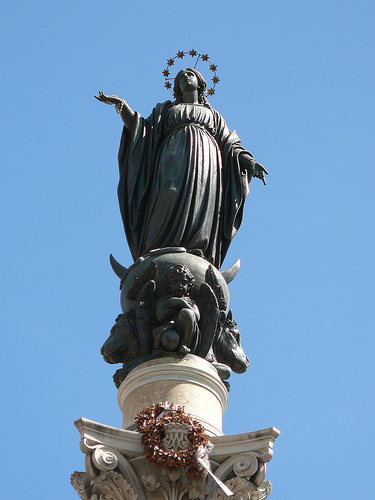 Pope Benedict XVI’s homily for the Solemnity of the Immaculate Conception in 2005, the first year of his pontificate, reflected on the fact that Pope Paul VI had closed the Second Vatican Council on this very same feast day in 1965. He points out that Mary had a central place in the Council, noting that she is “the great Believer who, full of faith, put herself in God’s hands, abandoning herself to His will” and “the humble Mother who when the Son’s mission so required, became part of it and at the same time, the courageous woman who stood beneath the Cross while the disciples fled.”
Continuing on, the pope emeritus makes a particularly striking point drawing on Gaudium et Spes and a central tenet of the Theology of the Body: “The Mother of the Head is also the Mother of all the Church; she so to speak, totally emptied of herself; she has given herself entirely to Christ and with him is given as a gift to us all. Indeed, the more the human person gives himself, the more he finds himself.”
Indeed the lack of self-giving is precisely what ails us in today’s culture. When we prepare engaged couples for marriage, for example, we spend quite a bit of time on what, to many, seems a foreign concept: trusting God with your life. In an “if-it-feels-good-do-it” and a “what’s-in-it-for-me” culture, we want to control everything ourselves, and the thought of trusting with all our being a benevolent, all-loving Creator, Who only wants what best for us can seem quite revolutionary.
With 75% of engaged couples cohabiting, and over 90% admitting to being sexually active before marriage, the concept of trust is more than a challenge. This lack of understanding of what marriage is, demonstrates a clear manifestation of a seriously destructive contraceptive mentality, where life and love have all but lost their meaning.
The good news however, is that Christ came to restore man and woman’s relationship to the order God intended from the beginning, and He provides a “way out” of our twisted perceptions of what love is. Pope Benedict explains:
“Love is not dependence but a gift that makes us live. The freedom of a human being is the freedom of a limited being, and therefore is itself limited. We can possess it only as a shared freedom, in the communion of freedom: only if we live in the right way, with one another and for one another, can freedom develop. We live in the right way if we live in accordance with the truth of our being, and that is, in accordance with God’s will. For God’s will is not a law for the human being imposed from the outside and that constrains him, but the intrinsic measure of his nature, a measure that is engraved within him and makes him the image of God, hence a free creature. If we live in opposition to love and against the truth – in opposition to God – then we destroy one another and destroy the world. Then we do not find life but act in the interests of death.”
How do we turn this upside-down world around? We can look to Mary to show us the way. Pope Benedict asks, “What does ‘Mary, the Immaculate’ mean? Does this title have something to tell us?” He goes on to answer these questions by pointing out two images in Scripture: the struggle between humanity and the serpent set forth in the book of Genesis, and the annunciation of the Messiah’s coming to Mary.
In Genesis, we see that the fall of Adam and Eve came about because they were deceived into not trusting in God’s plan. As the Catechism points out, “According to faith the disorder we notice so painfully…stems from sin. As a break with God, the first sin had for its first consequence the rupture of the original communion between man and woman” (CCC 1607). Because of the serpent’s deception, men and women throughout history have bought into the lie and grasp fruitlessly at all sorts of ways to control their own destiny instead of putting things into the hands of their loving Creator. This is so painfully manifest today by the high incidence of sexual activity outside of marriage, and the death-dealing acts of contraception and abortion.
But we must have hope! Despite the many manifestations of grave sin all around us, God so wants to heal and restore us, that He became Man to save us. By the gift of Mary, conceived without sin, He provided the pure vessel to be the Mother of the Savior.
“Like” Truth and Charity Forum on Facebook!
Mary’s fiat is a supreme act of trust in God. She knew she was loved beyond measure. She knew she was chosen. She put every aspect of her being in God’s hands, saying “Let it be done unto me according to Your word.” That simple “yes” changed the world forever. Pope Benedict helps us understand the Immaculate Conception this way: “The person who abandons himself totally in God’s hands does not become God’s puppet, a boring ‘yes man’; he does not lose his freedom. Only the person who entrusts himself totally to God finds true freedom, the great creative immensity of the freedom of good.”
In place of the destructive behaviors that only cause us heartache, let us look to Mary Immaculate, the new Eve, the Mother of the Redeemer, to lead us to the freedom of the truth and to share that truth with others, for nothing shall be impossible for God.
 Allison LeDoux is the director of the Respect Life Office and the Office of Marriage and Family for the Diocese of Worcester, MA. Her pro-life work in the diocese involves implementing the U.S. Conference of Catholic Bishops’ Pastoral Plan for Pro-Life Activities in which the Church is called to uphold the dignity of the human person from conception to natural death, and to proclaim the Gospel of Life through prayer, education, pastoral care, and public policy. She also oversees diocesan programs and policy related to Marriage Preparation with a particular focus on Pope John Paul II’s Theology of the Body, and teaches a class on the Theology of Marriage in the diaconate formation program.
Mrs. LeDoux serves as coordinator for the New England region of Diocesan Pro-Life Directors and is a member of the Massachusetts Catholic Conference’s Pro-Life/Pro-Family and Health Care Subcommittees. She received her certification in Catholic Health Care Ethics from the National Catholic Bioethics Center in 2007 and has had articles published in the National Catholic Bioethics Quarterly, Ethics & Medics and The Catholic Free Press.
Mrs. LeDoux and her husband, John, a permanent deacon, are the parents of eight children.


