


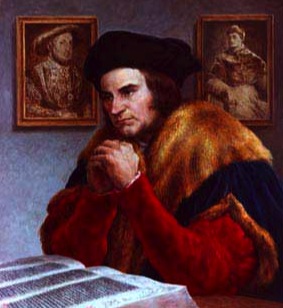
In one of the scenes from the film, A Man for All Seasons, Cardinal Wolsey seeks to elicit Thomas More’s help in obtaining a divorce for Henry VIII from Catherine of Aragon. More refuses and Wolsey asks if it is the result of a qualm of conscience. More points out that he cannot agree with the Cardinal because he thinks it is wrong to put pressure on the Pope. Wolsey says that his conscience may cause England to revert to civil war if there is no heir to the throne and so More should give in. More replies: “When statesman forsakes their private conscience for the sake of their public duty, they lead their country on a short route to chaos.”
There are many red herrings put up before those who have to vote in democratic elections concerning morality. Many say that the Church cannot compel someone to vote for Christian values. Others say that they are Catholic but then dissent from papal teaching on such subjects as contraception and abortion. Others claim that they are privately opposed to something as an evil but do not want to impose their morality on others.
To sort out the confusion caused by these red herrings some principles concerning morality and conscience would seem in order. First, both individuals and societies must be governed by objective human nature. In the past 300 years there was a theory of society which was very popular called the “social contract.” According to this theory, man was by nature totally free from both society and a moral law.
Because of evil, either caused by power or by money, men got together and decided to live in societies. They turned over their natural freedom from any higher law or authority to a sovereign, either the monarch or the people and this sovereign determined the law which in turn made things right or wrong.
A strange variation on this thesis was the totalitarian one in which the members of the society have no personal responsibility for their actions. So they rely on only one person to exercise responsibility in their name and that authority creates right and wrong.
 According to this theory which became very pervasive in the 20th century the will of the sovereign makes justice and injustice and is the origin of right. Such a view is completely contrary to both reason as taught by someone like Aristotle and faith witnessed in the moral teaching of the Scriptures. Both reason and faith presume a prior existing nature which can be investigated and for the most part defined as to the kinds of actions which fulfill human powers and those which do not.
Further, since this prior existing nature entails a spiritual soul together with a body, any moral theory which treats human actions without reference to the union of the body and the soul is false. Also, as Vatican II says in Gaudium et Spes, this prior existing nature is the foundation of the rights of the person which is expressed in the personalistic norm. This norm is based on the likeness of man’s soul to God and reveals “man who is the only creature on earth which God willed for itself, cannot fully find himself except through a sincere gift of himself” (24, 3).
This means there is something untouchable about the human person and that his nature as a union of a reasoning soul and body is the prior foundation of all rights. Traditionally this has been called the natural law which in turn is a reflection of the eternal law and must be respected in any action which is just. Justice is determined by rights which in their most basic sense are determined by nature.
Regarding conscience, the Church has regarded this as a syllogism in which laws and expressions of rights which are universal statements such as “Thou shalt not murder” are applied to individual conduct. The laws therefore also take their sanction from a prior existing human nature. No matter how powerful or how democratic the government might be, if they should declare something to be a right which is not in accord with the truth of man expressed in the natural law, such a right would not be a law but a usurpation of law.
Voting then must be guided by the truth. It is possible that a person would vote for a given imperfect candidate because even though they found some of their ideas about individual laws repugnant they recognize that a vote for such a candidate minimizes the evil that can be done when compared to an even more problematic candidate whose policies are worse.
For instance, this would be the case with a candidate whose policies would allow for abortion in the case of rape or incest versus someone who supports abortion on demand. This would presume that there was no electable candidate who opposed abortion in all cases. Even though both candidates approve abortion, one would save many babies. Their error has no right to exist but it would be a worse evil to elect the other candidate. Evil is tolerated here because of the possibility of a worse evil and the impossibility of completely establishing good.
Without the prior existing nature as the source for both rights and conscience all morals become relative and then only the most powerful determines even the right to life, who lives and who dies. The most powerful would then play God. It is only when statesman and voters do not forsake their private conscience for the sake of their public duty that any country can be saved from moral chaos.
 Father Brian Thomas Becket Mullady, O.P. is adjunct professor at Holy Apostles Seminary in Cromwell, Connecticut. In 1966, he entered the Dominican Order and he was ordained a priest in Oakland, California in 1972. Father Mullady received his Doctorate in Sacred Theology (STD) from the Angelicum University in Rome, Italy, where served as a professor for six years. He has taught at several colleges and seminaries in the United States and is an academician of the Catholic Academy of Science, the theological consultant to the Institute on Religious Life, and the author of the Question and Answer column in Homiletic and Pastoral Review. He has been featured in several series on Eternal Word Television Network (EWTN). The author of three books and numerous articles, Fr. Mullady has served as a parish priest, high school teacher, retreat master, and mission preacher.


