


No doubt, being a Roman soldier was a brutal life. Death surrounded the soldier on a daily basis. Between battles, scourgings, and crucifixions, the soldier dealt in finality of the physical human being in many different forms. This reality is emphasized quite dramatically in the opening scene of the movie “Risen”. A small force of Roman soldiers, led by a Roman Tribune, has apparently been sent out by Pontius Pilate to quell a Zealot uprising just outside of Jerusalem. It is bloody and it is ruthless.
The Tribune, Clavius, is an aspiring Roman military official. And after his bout with the Zealots, he is commanded by Pontius Pilate to oversee the crucifixion and burial of Yeshua, the Christ who made the bold prediction that he would rise in three days’ time. Truly, this was been a day of Death and as a way to wash off the blood of death we see both Clavius and Pilate relax in a Roman bath that very evening. It is during this time Pilate ask his Tribune what he most desires, and Clavius responds cautiously, “A day without death.” At the surface, it seems that he merely means he wishes to go through one day without having to witness the loss of life. Certainly, given his positon in life, it is understandable why he wishes for this. However, Clavius’ statement should be explored a little more deeply because it is not as simplistic as it sounds.
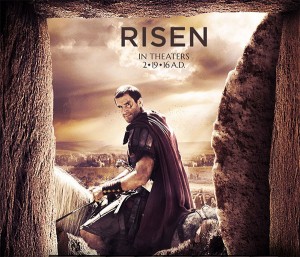 The movie itself primarily focuses on the idea of searching; for Clavius, it is that day without death. But in order to achieve the finality of this search there is path that the Tribune must take. At the beginning, after it has been reported that the body of Yeshua is missing, it focuses on finding the corpus of the Christ. The Apostles, fearful for their lives, have gone into hiding. It becomes the Tribune’s task to flush them out and then reveal the dead figure to the world to discredit the rumor of resurrection.
At the pivotal moment when the Apostles are found, Clavius actually encounters the risen Christ in the upper room where the Apostles are hiding from the investigating Romans. Literally, the Tribune is dumbfounded at what he is witnessing. All logic dictates that this man should be dead, after all this man died on the cross. The resurrected Yeshua invites the stunned Clavius into the room with his Apostles and the Tribune complies. It is at this point that the Roman officer has a life altering moment and it this astonishment is exemplified in a letter he leaves for Pilate, “I have seen two things which cannot reconcile: A man dead without question, and that same man alive again. I pursue Him, the Nazarene, to ferret the truth.”
This letter is pivotal. Not only does it verify that he is abandoning his post, an action which is considered treasonable and punishable by death, but that he is foregoing Roman culture. This is a fundamental change. Not only is Clavius merely leaving his military position, he is leaving things “Roman” in general. This is something to consider especially since ancient Rome embraced a culture of death. This should not be overly astonishing since the common person of the Roman Empire would have witnessed many public executions within a lifetime, may have participated in the common practice of infanticide, and would not have been adverse to the idea of “honor” suicide or abortion. These “customs” would have been part of the Roman culture. To emphasize how callous ancient Romans were with life consider the following passage from a letter from a Roman husband away from his pregnant wife, “If—good luck to you!—you should bear offspring, if it is male, let it live; if it is female, expose it” (quotation taken from The Triumph of Christianity by Rodney Stark, pg. 126). This is the ethos that Clavius had come from and it was the worldview he was beginning to walk away from.
This new search of the Tribune infuriates Pilate who orders Lucius, Clavius’ subordinate, to find the treasonous officer. It is in these moments that the viewer has a true appreciation for this new beginning for the military officer. He no longer wishes to harm these Apostles, but rather save them from the encroaching Roman forces. In some sense Clavius becomes messiah-like in this brief encounter insofar as he saves these eleven men from certain death. It even becomes more apparent that Clavius has a deeper appreciation for life when he spares the life of his former subordinate officer, Lucius. The faith of the Apostles and Clavius is rewarded when the Resurrected Yeshua appears again on the shorelines of Galilee.
It is here that Clavius has his full conversion when speaking with the Redeemer. In his conversation with the Savior, the Tribune is astonished when his very words, the desire for a day without death, are repeated to him. It is this moment when Clavius realizes the true value of all human life. Human beings, made by God and in the image of God, are to be respected. And that God loved mankind so much He became man as Scripture states, “All things came to be through him, and without him nothing came to be. What came to be through him was life, and this life was the light of the human race…And the Word became flesh and made his dwelling among us, and we saw his glory, the glory as of the Father’s only Son, full of grace and truth” (John 1: 3-4, 14).
After this encounter, Clavius is asked if he believes after his visit and conversation with the Resurrected Christ. He replies simply, “I believe. I can never be the same.” It becomes obvious that Clavius has not only embraced the Word as the messiah, but he has embraced the Culture of Life. Jesus’ words from the Gospel of John, “I am the way, the truth, and the life” have an even deeper meaning. Clavius has found Truth and embraced it, unlike his superior who famously asked Jesus, “What is truth?” Pilate’s skepticism, which symbolizes ancient Rome prior to its Christianization, embodies the lack of virtue and thusly, the culture of death. Clavius’ search for Truth (The Day Without Death) has been found and he has embraced Life itself.