


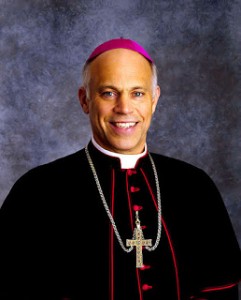
Being pro-life includes standing up for the traditional concept of marriage, says a bishop who is both a national spokesman for traditional marriage and the leader of the Archdiocese of San Francisco, one of the most gay-friendly towns in America.
Archbishop Salvatore J. Cordileone has yoked two social issues that have been understood to be separate and distinct.
In fact, there is some perception (particularly because the huge participation of youth and young adults in major pro-life demonstrations) that even if young Americans are much more conservative on abortion than their elders, they are more sympathetic to a redefinition of marriage.
 The Gallup polling organization in 2013 found that 70% of persons aged 18-29 supported legal same-sex “marriage,” a 29-point increase since 1996. Other age categories have shown similar increases, but the young adult group shows the strongest support.
Another recent Gallup survey found that only 54% of 18- to 29-year-olds call themselves “pro-choice,” a majority to be sure, but nothing near the support among the same age group for redefining marriage.
It might not be surprising then to learn that students at a Catholic school in Washington State, for example, were protesting the dismissal of a popular teacher there for having gotten “married” to another man.
In an age when blanket tolerance is upheld as a virtue, it has become difficult for many young people to criticize others for their “alternative” lifestyle choices—or to deny them their “pursuit of happiness” in marriage.
But the focal point in the marriage controversy must be the same as that in the abortion debate, said Archbishop Cordileone: the child.
“The pro-life movement is about more than saving the life of the baby,” the archbishop said during a Mass preceding the Jan. 25 Walk for Life West Coast in San Francisco. “It’s about giving that baby all the care, love and nurturing he or she needs to grow up happy and healthy and to achieve his or her total potential in life. It’s about the mother and a whole network of relationships around that baby that the baby needs in such a vulnerable stage of life.
“It’s especially about connecting that baby to where he or she came from: the mother and the father,” said the archbishop, who serves as the U.S. bishops’ conference point man in the defense of traditional marriage. “And that, my friends, is the whole point of marriage: to connect husbands and wives to each other and to any children they bring into the world. There is no other institution that does that, that connects children to their mother and father. Marriage is primarily about the children, not the adults, such that you cannot be consistently pro-life without being pro-marriage: the two go together. That’s the big picture.”
Marriage is under attack, he acknowledged, but that is not simply because states in the past 10 years have begun allowing marriage for same-sex couples. An attack on the “big picture” that marriage is integral to the pro-life cause “has been going on in our society for a very long time now, actually, for at least as long as the abortion-rights movement has been in existence,” he said.
A rehearsal of some of the ideas the abortion movement has spouted over the years would seem to back him up. Abortion, the movement promised, would lead to women’s liberation and equality—implying that marriage’s necessary connection to childbearing subjugates women. The Constitution guarantees a right to privacy, they said, and therefore abortion must be a decision between a woman and her doctor—suggesting that a woman’s husband, who helped generate the life, is excluded from such a decision.
But abortion is not simply a private decision a woman makes for her own good. Somehow, it always involves the father of the child as well—or necessitates a severance of their relationship. Even if the man and woman both agree to an abortion, each fails to support the other in choosing the good for their offspring. Or, perhaps, a woman decides to abort without the consent of the child’s father or is pressured by the child’s father into an abortion or abandoned by the child’s father and left to think abortion is her best option.
Archbishop Cordileone touched on this dynamic when he told his listeners, “A baby in the womb is thrown away because at least one of the two people who brought that baby into the world has thrown the other away, has rejected the other as someone worthy of commitment, self-surrender, and unconditional love. This is what marriage is and is for: not a privileged social status, not a government recognition of people’s love life, not a special relationship one stays in as long as one is deriving some immediate benefit from it, but a self-surrender of husband and wife to each other for the sake of the children they bring into the world.”
A couple of months ago, I asked Ryan T. Anderson, co-author of the book What Is Marriage, why young people are very sympathetic to the “marriage equality” cause, even as they seem to be more pro-life. “I think it’s largely that they haven’t had the argument made to them,” he said. While the pro-life cause has blossomed with all kinds of rallies, organizations, crisis pregnancy centers, educational initiatives and academic support, similar work has barely gotten off the ground in regards to the marriage issue.
But now Archbishop Cordileone has given it a good push, and a framework for making the argument that being pro-traditional marriage is being pro-life.