


“To act follows (or manifests) the being of a thing” is a revered Scholastic axiom, which rendered more tightly in its original Latin form as Agere sequitur esse.
In the 1927 musical, Showboat, Oscar Hammerstein wrote the following words for the beginning of the hit song, “Can’t Help Lovin’ Dat Man,” that demonstrates the perennial validity of these afore-stated axioms:
Fish got to swim,
Birds got to fly,
I gotta love . . .
Nothing is so closed in on itself that it does not have a natural propensity to express what it is. Nothing is completely free of the nature that grounds it in reality.
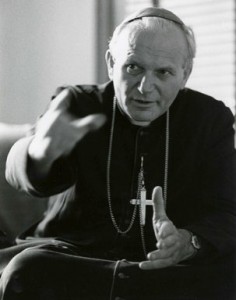
Concerning the human being, Blessed Pope John Paul II stated in his encyclical Redemptor hominis, that “man cannot live without love. He remains a being that is incomprehensible for himself, his life is senseless, if love is not revealed to him, if he does not encounter love, if he does not experience it and make it his own, if he does not participate intimately in it.” For John Paul, love is primary, even metaphysical. It is man’s basic principle for “self-realization,” his most elementary “person-act.”
Subsequently, the person and the personal love that flows from him are profoundly, intimately, and inseparably bound together. The person and the personal can be seen as two different modes of the same being. Just as it would be wrong to prevent fish from swimming or birds from flying, it would be wrong to prevent or even discourage human persons from loving.
A person, because of the way he is constituted, has a right to be personal, a right, that is, to love. To be an authentic person, then, is to be a lover, to live and act interpersonally, with others through giving and receiving. This point has an important bearing on the unique contribution that John Paul has made for bioethics.
When Cain said to God, “Am I my brother’s keeper?”, as John Paul has remarked in his encyclical, Evangelium Vitae, he was indicating his refusal to accept the responsibility that every person has toward others. Moreover, he was not only refusing to act as a person, but even to acknowledge that he is a person. Cain was making the futile effort to become estranged from his own nature.
Above all, as an academic, Blessed John Paul (Wojtyla) was a “personalist” philosopher. His most important and characteristic intellectual work is The Acting Person, which was first published in 1969 when he was a philosophy professor at the University of Lublin. In this work, he develops the notion that the person, and how he reveals himself through his action, are intimately bound up with each other. “Action gives us the best insight,” he writes, “into the inherent essence of the person and allows us to understand the person most fully.
We experience man as a person, and we are convinced of it because he performs actions.” In elaborating on the inherent unity of the person and the personal, Wojtyla repudiated the closed ego concept of the human being that René Descartes advanced that has had such a profound effect on modern thinking. For Wojtyla, the person is more than the isolated individual that Descartes described, but a person inclined by his very nature to love and form communities of persons with other human beings.
 Marriage, as well as the family, are “communities of persons,” as John Paul states in his Apostolic Exhortation, Familiaris Consortio. The community of the husband and wife in marriage represents a particularly intimate and natural unification of the person and the personal inasmuch as it takes on the character of a “two-in-one-flesh” unity.
In repudiating Cartesianism, Wojtyla was also providing strong argumentation against many American psychologists—Carl Rogers, Abraham Maslow, Eric Fromm, Rollo May, Frederick S. Perls, Richard Harris, Nathaniel Brandon, among others—who popularized various brands of individualism.
Paul Vitz, whose careful analysis of this phenomenon appears in his book, Psychology as Religion: The Cult of Self-worship, comments that “when Carl Rogers titles his best known work, “On Becoming a Person,” he is simply wrong. Instead, what Rogers wrote was a book about becoming an individual—an autonomous, self-actualizing individual who is devoted to the growth of the secular self. But he is not talking about the person.”
Rogers, who welcomed the split between the person and the personal (resulting in “selfism” or “unconditional self-regard”), has no treatment at all of love in his book On Becoming a Person. Consistent with his individualistic framework, he predicted that by the year 2000, sex would have almost completely lost its role in procreation. Harvard sociologist Gordon Allport lamented that “A persistent defect of modern psychology is its failure to make a serious study of the affiliative desires and capacities of human beings.”
In the present-day world of bioethics, it is commonplace for people to believe that they can make morally valid decisions based on the notion that they are “autonomous” beings who act for themselves alone and not persons who are called to love others in a personal way.
Consequently, many believe that they have a “right” to have a baby, to take but one example, and to the technology that could satisfy their desires. The “autonomous” person would also have a “right” to abortion, contraception, and other questionable bioethical procedures.
Throughout the two Vatican statements on bioethics, Donum vitae (1987), and Dignitas personae (2008), there are abundant statements indicating that an unbroken continuum should exist between the intimate act of personal love between spouses and the new life that is its fruit.
Reiterating what was written in 1987, Dignitas personae once again honored the “unconditional respect owed to every being at every moment of his or her existence, and the defense of the specific character of the personal act which transmits life.” The dignity owed to the person (of any age) should be extended to those intimately personal acts of love between husband and wife that by their nature invoke new life.
There is no other suitable context than personal love between spouses that is appropriate for allowing love to be extended, without interruption, to a new human being. Because of the dignity inherent in the person, no person should be made an object of anyone else’s desire. Because love is essentially generous, love is the only fitting way to establish a proper relationship with new life.
There have been many personalist thinkers in the modern world. Yet no one has analyzed the nature of the person and the personal love that naturally flows from the person as thoroughly and as extensively as John Paul. His contribution in clarifying the primacy and the inseparability between the person and the personal provides a most significant moral principle undergirding a truly moral bioethics.
No technological intervention should violate the dignity of the person. Moreover, no technological intervention should alienate personal love from the begetting of new life. Respect for new life is a continuation of respect for the person. Therefore, Dignitas personae states that “it is ethically unacceptable to dissociate procreation from the integrally personal context of the conjugal act.”
John Paul, over the course of his life as an academic, priest, bishop, cardinal, and pope, has produced an impressive philosophical and theological argumentation against two popular misconceptions: 1) that a person is an autonomous individual and therefore has the right to employ biomedical technology solely according to his private preferences; 2) that the love that flows naturally from the essence of the human being, especially in the domain of procreation, can be adequately replaced by technological procedures.
The contemporary world, to a significant extent, either misunderstands the nature of the human being as a person, or fails to appreciate the irreplaceable value of personal love.
Blessed Pope John Paul II has redressed these problems with superlative insight. The “acting person” reveals himself through personal love. Such love serves to safeguard and promote the good of other persons. Every person is “inviolable,” “unrepeatable,” and “irreplaceable.” Bioethics can serve man well as long as it does not violate the dignity of the person or disregard the intrinsic value of personal love.
 Dr. Donald DeMarco is a Senior Fellow of Human Life International. Doctor DeMarco is a member of the Pontifical Academy for Life and he is Professor Emeritus at St. Jerome’s University in Waterloo, Ontario and an adjunct professor at Holy Apostles College & Seminary in Cromwell, CT.
He is the author of 22 books, including; Architects of the Culture of Death, The Many Faces of Virtue, The Heart of Virtue, and New Perspectives on Contraception. He has authored several hundred articles in scholarly journals and in anthologies, and articles and essays appearing in other journals and magazines and in newspapers; and innumerable book reviews in a variety of publications.
His education includes: B.S. Stonehill College, North Easton, MA 1959 (General Science); A.B. Stonehill College, 1961 (Philosophy); Gregorian University, Rome, Italy, 1961-2 (Theology); M.A. St. John’s University, Jamaica, NY, 1965 (Philosophy); and Ph.D. At. John’s Univ., 1969 (Philosophy). His Master’s dissertation was “The Basic Concept in Hegel’s Dialectical Method” and his Doctor’s dissertation was “The Nature of the Relationship between the Mathematical and the Beautiful in Music”.
He is married to Mary Arendt DeMarco and they have five children.

 PDF
PDF