


One hundred and forty four years separate the first woman and the most recent woman who campaigned for the presidency of the United States. Despite this extended period of time, during which America has changed dramatically, it is interesting to note that the lives and views of Hillary Clinton and Victoria Woodhull are similar in ways that are striking. Plus ça change, plus c’est la même chose (The more things change, the more they stay the same.).
Who is Victoria Woodhull? A journalist writing for the Atlanta Journal & Constitution deftly captured her eccentric personality when he said, “If you spliced together Hillary Clinton, Madonna, Heidi Fleiss and Margaret Thatcher, you might have someone like Victoria Woodhull.” The comparison with Hillary Clinton is justified. Both were ardent feminists who had liberal views on sex, love, marriage, contraception, and divorce. Both were married to men who took a dim view of marital fidelity. And both were haunted by the law.
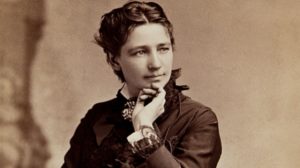
Victoria Woodhull
Victoria Woodhull was nominated for president of the United States on May 10, 1872 by the newly form Equality Party. She ran on the platform of prostitution, vegetarianism, spiritualism, birth control, and free love. By the latter, she meant the freedom to marry, divorce, and bear children without government interference. “Yes, I am a Free Lover,” she stated. “I have an inalienable, constitutional and natural right to love whom I may, to love as long or as short a period as I can; to change that love every day if I please, and with that right neither you nor any law you can frame any right to interfere.” She was a forerunner to Margaret Sanger who founded Planned Parenthood. Frederick Douglas, a former slave, declined being Woodhull’s vice-presidential running mate for fear that his acceptance of that post would have adversely affected his future.
Her arrest on an obscenity charge a few days before the election added to her already scandalous image. She spent the eve of the election in jail. Because, at that time, women were not allowed to vote, she could not vote for herself. She received no electoral votes. Biographer M. M. Marberry claimed that she received exactly no votes. However, an unrelated man in Texas admitted voting for her as a protest against Ulysses Grant.
Woodhull’s life and views were sufficiently disreputable that her twelve-year-old daughter had to assume an alias in order to attend school without being harassed. Because of her sullied reputation, she could not find housing in Manhattan. Exhausted and burned out, the “Queen of the Quill,” as she was called, fled to England where she remained until she passed away at the age of 88, twenty years before the birth of Hillary Rodham Clinton. The mood of America was not on her side during her brief and turbulent political life. It would be an understatement of considerable magnitude to say that she was not a person for the times in which she lived.
But how the public attitude toward her has changed! In 2003, the Woodhull Sexual Freedom Alliance, an American human rights and sexual freedom advocacy group, was named in honor of Victoria Woodhull. On September 26, 2008, St. John’s University Law School in Queens New York, a Catholic institution, posthumously awarded her the “Ronald H. Brown Trailblazer Award”. Victoria Bond composed the opera “Mrs. President” about Victoria Woodhull which premiered in Anchorage, Alaska in 2012. The 1980 Broadway Musical, Onward Victoria was inspired by Woodhull’s life. Several female writers have penned her biography. The accolades are numerous.
The once scandalous eccentric of 1872, is now, at least in certain circles, an honored figure. One may ask the question, “Is Victoria Woodhull looking more like Hillary Clinton today, or is Hillary Clinton looking more like Victoria Woodhull?” Victoria Woodhull’s image is a barometer that indicates how drastically attitudes toward morality have changed.
There is one significant difference between Victoria and Hillary, though it is a tenuous one. Woodhull opposed abortion. “The rights of children as individuals,” she wrote, “begin while they yet remain the foetus.” But her stance was unrealistic and one that would logically and inevitably lead to the acceptance of abortion. “Every woman knows,” she claimed, “that if she were free, she would never bear an unwished-for child, nor think of murdering one before its birth.” In this regard, Woodhull was anticipating the mantra of “reproductive freedom” and “control of my body”. Such radical freedom and control, of course, do not exist. Unwanted pregnancies persist and human beings remain as mortal and prone to the vicissitudes of life as ever before.
Hillary and Victoria are dreamers. They both believe in a freedom that is impossible. At the same time, both reject a moral order, especially in the sexual sphere, that, if followed, can bring about a more realistic kind of freedom, namely, the freedom of personal authenticity. Freedom apart from the moral order is an illusion.
When we examine “now” and “then,” Hillary and Victoria, we realize that our moral obligations remain the same. Sex within marriage, fidelity between spouses, and the parental care of children continue to be fundamental moral obligations. And these obligations are not restrictions but ways in which we can better realize who we are as responsible human beings.
 Dr. Donald DeMarco is a Senior Fellow of Human Life International. He is professor emeritus at St. Jerome’s University in Waterloo, Ontario, an adjunct professor at Holy Apostles College in Cromwell, CT, and a regular columnist for St. Austin Review. His latest works, How to Remain Sane in a World That is Going Mad and Poetry That Enters the Mind and Warms the Heart are available through Amazon.com.
Articles by Don:


