


All radical ideologies specialize in social engineering, reconstructing the nature of things to create a more ideal, utopian, perfect, and just world. While social engineering attempts to transform society in revolutionary ways like Communism or socialism in the name of equality, social justice, and the classless society, it ultimately means some attack on the traditional family and the roles of father and mother or some subversion of an ancient moral truth. Glorifying work, Marxist philosophy places woman outside the family and into the work force, elevating the production of labor more than the education of children in the home. Devaluing motherhood and marriage, feminist ideology classifies men as unnecessary to feminine fulfillment and regards feminine autonomy in matters of reproductive freedom as an absolute right that supplants even the child’s right to life in the womb. Alarmist about global warming and the state of the planet, environmentalist ideology aims to reduce population growth and limit families to protect the quality of life on Mother Earth. Presuming to reinvent the meaning of marriage and family on the basis of “equality under the law” to accommodate everyone’s pursuit of happiness, liberal ideology ignores the best interests of the child by depriving the young of both a mother and father’s influence and example.
Although the phrase “social engineering” is a recent term, it appears throughout literature as a type of experiment intended for improvement of the status of things. Although social engineering promises a more efficient world, a happier life, greater freedom, and an elimination of injustices, the experiments always multiply human problems and spread misery that result in man’s dehumanization. In Huxley’s Brave New World utopian ideas attempt to impose a man-made, scientifically constructed world upon a natural order and divinely ordained universe in the name of “a prodigious improvement” of Mother Nature. In the novel The Fertilizing Room under the supervision of the Director of Hatcheries and Conditioning replaces marital union and human procreation as biotechnology boasts of selective breeding: “eleven thousand brothers and sisters in a hundred and fifty batches of identical twins.” Children, then, are manufactured in mass production and not conceived in love as the fruit and blessing of marriage. The human and personal disappear.
I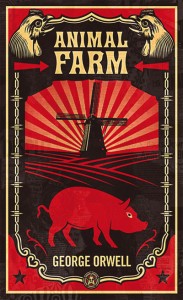 n Orwell’s 1984, social engineering assumes the form of revisionist history under the authority of the Ministry of Truth: “Every record has been destroyed or falsified, every book has been rewritten, every picture has been repainted, every statue and street and building has been renamed, every date has been altered” in the name of reinventing reality to accommodate man’s desires: “Whatever the Party holds to be truth is truth.” Water is not wet, rocks are not hard, and it is not self-evident that 2+2=4. Reality does not conform to metaphysical truths or any higher laws than man’s wishes. As O’Brien indoctrinates Winston, “reality exists in the human mind, and nowhere else,” and therefore Winston must never think that “reality is something objective, external, existing in its own right.” Reality, then, is variable, subjective, and relative—something to be manipulated and reinvented by political ideologies.
In Orwell’s Animal Farm, the animals overthrow the tyrannical rule of Mr. Jones to initiate a utopian “golden future time” based on the commandment that “All animals are equal”—a rule of law that will improve the lot of all the beasts of burden with more rations, more leisure, and more liberty. The dark ages of the primitive past have ended. But all the Seven Commandments of Animal Farm soon undergo revision to benefit only Napoleon’s self-interest as might becomes right again under the new regime. “All animals are equal, but some are more equal than others” replaces the earlier commandment. “No animal shall kill any other animal without cause” modifies the original commandment that no animal is allowed to kill any other animal. “No animal shall sleep in a bed” is revised with the addition of the phrase “with sheets.” The utopian golden future time promised by the new government never achieved the glorious revolution it imagined because Napoleon twisted truth to be self-serving and changed the meaning of law to pander to pleasure rather than modifying desires to conform to truth and justice.
Proverbial wisdom, however, cautions mankind about subverting natural order and rejecting self-evident truths. In the Grimm folktale “The Mouse, the Bird, and, the Sausage” someone proposes a new domestic arrangement to improve the inequalities of division of labor. In the past, the bird flew abroad to carry wood for the fire; the mouse brought water, made the fire, and set the table; and the sausage performed all the cooking. While the bird accomplishes the errands of fetching wood with no complaint, another bird (a social engineer), one who does not share in their domestic life, calls attention to the inequality of the situation–the injustice of a small bird always burdened with the hardest task of traveling abroad while his two companions suffer less labor and enjoy more comfort in the home. Protesting of the unfair division of hard labor and proposing a new experiment, the bird vows never again to bear the onus of gathering wood. Social Engineering will improve Mother Nature.
As the three companions exchange roles, the sausage now does the traveling to gather the wood. The bird remains home to stir the fire. And the mouse performs the cooking and no longer sets the table. Under this new scheme of things all natural order disintegrates when a dog devours the sausage traveling abroad. As the mouse, imitating the manner of the sausage, enters the pot to flavor the food, the heat soon cooks his fur and takes his life. When the bird finds no sausage carrying water and sees no mouse cooking the pot, he finds himself at a loss. Noticing the wood catching fire, he goes to bring the water to extinguish it only to fall in the well with the bucket and drown. As this tale illustrates, the old traditional way made more sense than the new experimental method. The old arrangement corresponded to the nature of things–to the three companions’ qualifications, abilities, strengths, and weaknesses–and it maintained harmony and order in the home: “Once upon a time, a mouse and a bird and a sausage lived and kept house together in perfect peace among themselves, and in great prosperity.” Social Engineering destroyed the home.
A bird does not have to be a sausage, and a mouse does not have to be a bird, and the sausage does not have to be a mouse. Mother Nature’s higher wisdom always prevails. Social engineering has no basis in reality, nature, reason, or tradition. It never improves but deconstructs. It does not advance justice but violates natural laws. It brings no golden age but undoes civilization, morality, and the common good. The home and family do not suffer experimentation but abide by unchangeable laws that have prevailed throughout the ages of ages. The social engineering of China’s one-child policy has destroyed an ancient civilization centered on the family, and it has now created an unnatural imbalance between males and females in which over 50 million men are missing women to marry and found families. Social Engineering always attacks the family, undoes Nature’s wisdom, and deconstructs civilization.
 Mitchell Kalpakgian, Ph.D. has completed fifty years of teaching beginning as a teaching assistant at the University of Kansas, continuing as a professor of English at Simpson College in Iowa for thirty-one years, and recently teaching part-time at various schools and college in New Hampshire. As well as contributing to a number of publications, he has published seven books: The Marvelous in Fielding’s Novels, The Mysteries of Life in Children’s Literature, The Lost Arts of Modern Civilization, An Armenian Family Reunion (a collection of short stories), Modern Manners: The Poetry of Conduct and The Virtue of Civility, and The Virtues We Need Again. He has designed homeschooling literature courses for Seton Home School, and he also teaches online courses for Queen of Heaven Academy and part-time for Northeast Catholic College.


