


We hardly need a reminder that marriage is under attack, both in the world and the Church. The attack on marriage within Holy Mother Church is perhaps the most devastating, leaving members of the laity confused and troubled. In his ongoing debate over admitting the divorced and remarried to Communion, Cardinal Kasper’s proposals have done more harm than good for the Church and world. While his provocative perspectives have brought about much discussion, they do little for those who do not understand the Church’s teaching on marriage, especially with regard to indissolubility. We shall look at the Church’s understanding of indissolubility and then compare it with Kasper’s proposals about determining invalid marriages.
In an interview with Commonweal, Cardinal Kasper said that choosing to live together as brother and sister after divorce and remarriage is a heroic act, but “heroism is not for the average Christian.” With this understanding of the Christian life, one could hardly see how living the marital vow of indissolubility would be possible. It is a command from Christ Himself, who says, “What therefore God has joined together, let no man put asunder” (Matthew 19:6). Indeed, even His own disciples were shocked at this teaching, saying, “If such is the case of a man with his wife, it is not expedient to marry” (Matthew 19:10). To our modern ears, then, such a command would be seemingly impossible, perhaps even ridiculous, considering our current tendency to lead disjointed lives seeking to fulfill selfish desires.
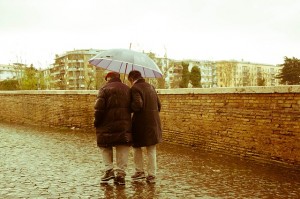 Nevertheless, the Church continues to uphold Christ’s command regarding the indissolubility of marriage. Pope Benedict XVI said in a homily, “Marriage, as a union of faithful and indissoluble love, is based upon the grace that comes from the triune God, who in Christ loved us with a faithful love, even to the Cross.” Here we find the heart of the teachings of indissolubility. Marriage between a man and woman mirrors the love of Christ for man, since, after humbling Himself and taking on human flesh, He willingly suffered the most heinous and grievous suffering: crucifixion (Philippians 2:5-8). Christ took on human flesh so that He might suffer and die to redeem man, to open the gates of heaven to him. This is the very love that constitutes the wedding vows: the couple promise to be with each other until the very end of life, regardless of the sufferings they may face along the way. This love is sacrificial, for it surrenders any selfish purposes for the good of the spouse. At the same time, marriage is a grace, as Benedict says, meaning that the strength to fulfill such a vow comes from God, not man’s own power. Moreover, as Pope St. John Paul II said, “the good of indissolubility is the good of marriage itself” (emphasis in original). Clearly, such a good is not so easily dispensable if it constitutes the good of marriage.
We find, however, in Cardinal Kasper’s seemingly modest proposal entitled, The Gospel of the Family, a propensity to disdain this indissolubility, which is upheld by sacrificial love, although he says, “The indissolubility of a sacramental marriage and the impossibility of contracting a second marriage during the lifetime of the other partner is a binding part of the Church’s faith tradition” (Paulist Press). Such a view is contradicted in the first of Kasper’s proposals to solve the problem of the divorced and remarried. His first proposal, which is the only one we shall consider here, involves changes to the judicial system in the Church. Currently, according to canon 1060, “Marriage possesses the favor of the law; therefore, in a case of doubt, the validity of a marriage must be upheld until the contrary is proven.” In other words, we presume that all marriages are valid, regardless of any claims made by either party. Thus, until proven otherwise, all marriages are assumed to be valid.
Kasper writes something quite the opposite. He says, “Many pastors are in fact convinced that many marriages, which were concluded in ecclesial form, are not validly contracted.” We cannot help but be startled by such a claim. While the courts uphold the validity, and therefore indissolubility, of the marriage, pastors themselves, who officiate at the marriages, do not believe they are valid. Oftentimes, as Kasper’s argument implies, it is because of invincible ignorance, which many pastors believe the couples to have if they are unaware of the indissolubility of marriage. If the burden of indissolubility is not placed upon them—if they are not called to the heroic act of selfless love—then they cannot be blamed for divorcing and remarrying.
It is into these pastors’ hands, then, that Cardinal Kasper wishes to place the burden of the declaration of nullity. Despite his claim that he wishes to avoid a “generous expansion of the annulment process,” he proposes that the bishop could appoint “a priest with spiritual and pastoral experience as a penitentiary or episcopal vicar.” The very priests who believe that most marriages are invalid would be responsible for declaring marriages invalid or valid. Such a process could only lead to chaos and confusion, and more Catholics will see the declaration of nullity process as a “Catholic divorce,” which could not be further from the truth.
Regarding this issue, Stephan Kampowski, professor of philosophical anthropology at the Pontifical John Paul II Institute for Studies on Marriage and Family in Rome, comments accurately, “If the conviction of many pastors turns out to be really true, it cannot possibly be considered as a path to partial resolution of the problems connected with the divorced and civilly remarried. It is itself the major problem.” If we do not call married Catholics higher to the vow of indissolubility but only meet them where they are at, believing that most have contracted invalid marriages, then we will only perpetuate the problem and cause further division and scandal within the Church. Rather, we must continue to uphold the Church’s teaching on indissolubility and emphasize the importance of the nullity process. Otherwise, we can do nothing but live up to Kasper’s expectation of being unheroic Catholics.
 Veronica Arntz is a senior at Wyoming Catholic College, located in Lander, WY. The rigorous Classical curriculum includes courses in humanities, theology, philosophy, rhetoric, Latin, mathematics, and an added emphasis in outdoor leadership. Ms. Arntz recently interned with the Diocese of Madison in the Marriage and Family Department and with Vigil for Life of Madison.


