


“Deep within his conscience man discovers a law which he has not laid upon himself but which he must obey. Its voice, ever calling him to love and to do what is good and to avoid evil, sounds in his heart at the right moment. . . . For man has in his heart a law inscribed by God. . . . His conscience is man’s most secret core and his sanctuary. There he is alone with God whose voice echoes in his depths.” (Catechism of the Catholic Church, n. 1776)
This beautiful definition of conscience is described in the Catechism of the Catholic Church at paragraph 1776. It was none other than one of the Little Sisters of the Poor who pointed out the “Divine coincidence” of this paragraph number in light of our current struggles in the fight for religious freedom. After all, 1776 is the birthday of America, a nation whose very constitution proclaims the fundamental rights to life and religious liberty.
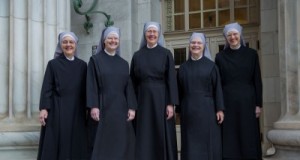 Why is this important? These fundamental rights are particularly important today because the very soul of our nation is in peril. The Little Sisters of the Poor are a religious order serving in the U.S. since 1868. Faithful to their profoundly beautiful and humble mission, they currently care for 13,000 elderly poor in 30 homes across the U.S. and in 31 countries world-wide. One would expect that even the most hardened of hearts could not help but be in awe of the love, kindness, and dedication of these Sisters. And yet, astoundingly, for the past several years, the Little Sisters have been engaged in an unwarranted battle with the federal government. The U.S. Department of Health and Human Services is trying to force the Little Sisters to violate their conscience by complying with the HHS mandate to provide abortifacient contraception, sterilization, and abortion-inducing drugs in their employees’ health plans. The government claims that the Sisters are not “religious enough” to qualify for an exemption. Now the case is headed to the land’s highest court.
On March 23, the United States Supreme Court will hear oral arguments in “Zubik vs. Burwell”, a religious freedom case that could easily be one of the most significant of modern times. The Little Sisters of the Poor, who are facing fines of $70 million per year, join six other plaintiffs (Archbishop Zubik, Priests for Life, the Roman Catholic Archdiocese of Washington, Houston Baptist and East Texas Baptist Universities, Southern Nazarene University, and Geneva College) in seeking relief from the mandate.
In a press release at the filing of the brief at the Supreme Court, Mark Rienzi, Senior Counsel of the Becket Fund for Religious Liberty which represents the Little Sisters of the Poor, said, “The Little Sisters spend their lives taking care of the neediest members of our society – that is work our government should applaud, not punish.” The Sisters’ Mother Provincial, Sr. Loraine Marie Maguire, added, “As Little Sisters of the Poor, we offer the neediest elderly of every race and religion a home where they are welcomed as Christ. We perform this loving ministry because of our faith and cannot possibly choose between our care for the elderly poor and our faith, and we shouldn’t have to. All we ask is that our rights not be taken away. The government exempts large corporations, small businesses, and other religious ministries from what they are imposing on us – we just want to keep serving the elderly poor as we have always done for 175 years. We look forward to the Supreme Court hearing our case, and pray for God’s protection of our ministry.”
One of the government’s devious tactics in trying to coerce the Little Sisters and other non-profit ministries to violate their conscience is a so-called “accommodation”. It is nothing of the sort. Sr. Constance Veit, the Little Sisters’ Director of Communications, in a recent article called “Why We Can’t ‘Just Sign the Form’”, explained that what the government wants them to sign is “neither a simple declaration of conscientious objection, nor an ‘opt out’ regarding the HHS Mandate. Form 700 is a permission slip. Signing it would allow HHS to commandeer the infrastructure of our health care plan in order to use it to distribute abortifacients and contraceptives to our employees…[it] would involve us in formal cooperation with wrongdoing, which is never permissible…Through our vow of hospitality we are bound, in the eyes of God and the Church, to upholding the sanctity of human life from the moment of conception until natural death. Very simply Form 700 involves the taking of innocent human life. That is why we cannot ‘just sign the form’.”
The Founding Fathers would no doubt agree. The very principles on which this nation was established are at stake. For example, George Washington said, “Religion and morality are the essential pillars of civil society.” Thomas Jefferson said, “God who gave us life gave us liberty at the same time.” James Madison said, “The Religion then of every man must be left to the conviction and conscience of every man; and it is the right of every man to exercise it as these may dictate. This right is in its nature an unalienable right… Conscience is the most sacred of all property.”
Dignitatis Humanae, the Second Vatican Council’s Declaration on Religious Freedom puts it this way: “The human person has a right to religious freedom. This freedom means that all men are to be immune from coercion on the part of individuals or of social groups and of any human power, [and] no one is to be forced to act in a manner contrary to his own beliefs, whether privately or publicly, whether alone or in association with others…” (n. 2)
During his trip to the United States last fall, Pope Francis showed his support for the Little Sisters of the Poor when he paid them a special visit at their Washington, DC residence. Just a few days later, no doubt inspired by the Little Sisters fidelity to Christ and His Church, the Holy Father reiterated the vision of America’s Founding Fathers and the Second Vatican Council in his speech at Philadelphia’s Independence Hall: “It was here that the freedoms which define this country were first proclaimed. The Declaration of Independence stated that all men and women are created equal, that they are endowed by their Creator with certain inalienable rights, and that governments exist to protect and defend those rights…when a country is determined to remain true to its principles, those founding principles based on respect for human dignity, it is strengthened and renewed….Let us preserve freedom. Let us cherish freedom. Freedom of conscience, religious freedom, the freedom of each person, each family, each people, which is what gives rise to rights….And may you defend these rights, especially your religious freedom, for it has been given to you by God Himself.”
As we await the oral arguments at the Supreme Court, and the Court’s decision which is expected to follow within a few months’ time, we know it is a time for focused prayer. Our faith can be strengthened by reflecting on the story in the third chapter of the Book of Daniel which tells the story of the three young men, Shadrach, Meschach, and Abednego, who were thrown into the fiery furnace when they refused to worship King Nebuchadnezzar’s god. The young men’s steadfastness and fidelity to their conscience and their Creator were rewarded. They were able to walk through the fire without being harmed and the angel of God walked with them. Moreover, Nebuchadnezzar’s rage was turned into a holy fear of the Lord; when he saw what happened, he too, praised the One True God.
May God’s justice prevail and may He continue to guide and protect the Little Sisters of the Poor and all those who courageously stand for Truth. And may we all follow their Christ-like example. Let them serve!
Author’s note: The following websites are helpful in learning more about the Little Sisters of the Poor and their religious freedom case:
- The Becket Fund for Religious Liberty
- Little Sisters of the Poor – homepage, case, prayer support
- #LetThemServe
 Allison LeDoux is the director of the Respect Life Office and the Office of Marriage and Family for the Diocese of Worcester, MA. Mrs. LeDoux serves as coordinator for the New England region of Diocesan Pro-Life Directors and is a member of the Massachusetts Catholic Conference’s Pro-Life/Pro-Family and Health Care Subcommittees. She received her certification in Catholic Health Care Ethics from the National Catholic Bioethics Center in 2007.Mrs. LeDoux and her husband, John, a permanent deacon, are the parents of eight children.


