


Many people today say quite glibly that their pets love them unconditionally. We need to be realistic here. They love us because they are fed, petted and cared for. We love them and they are glad to see us, lick our faces out of affection, and even sometimes protect us from harm. Likewise, we also believe that God loves us but He is not a pet and He loves us unconditionally—no matter how we may offend Him. He does not give up loving us because He wants to save us so that we can be with Him forever in his kingdom.
The Incarnation and Redemption are the great signs and causes of God’s merciful love for us. As Creator, He became our redeemer from all sin by his passion, and death. Those violent acts inflicted unjustly upon His body were the instruments of making reparation for the sins of all mankind, original and personal together with His virtues of merciful love offered to the Father. Objectively, the Lord Jesus forgave all sin of all times for human beings. However, to receive personal forgiveness, subjectively one must repent to receive the fruits of His saving actions. But what does it mean to repent?
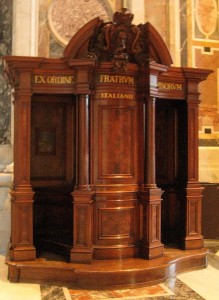 Babies are baptized and original sin is taken away from them without personal repentance because they have not committed any sins. Older children, adolescents and adults can be baptized but they need to be truly sorry for their previous sins. If they do not have sorrow for sin, they are validly baptized but their sins are not forgiven. RCIA personnel need to keep in mind that there has to be a stage in the program somewhat like Alcohol Anonymous’s Step Four, where one examines his or her life and recognizes the evil one has done, hates it and sorrows over it while begging God for mercy. St. Thomas Aquinas reminds us what this entails:
…For just as the inflation of one’s own will unto wrong-doing implies, in itself, a generic evil, so the utter undoing and crushing of that same will implies something generically good, for this is to detest one’s own will whereby sin was committed. Wherefore contrition, which signifies this, implies rectitude of the will; and so it is the act of that virtue to which it belongs to detest and destroy past sins, the act, to wit, of penance…. (ST Suppl. 1, 2).
Likewise, the Catechism of the Catholic Church affirms Aquinas when it explains that part of being justified with God, that is, turning to Him, requires the following:
Interior repentance is a radical reorientation of our whole life, a return, a conversion to God with all our heart, an end of sin, a turning away from evil, with repugnance toward the evil actions we have committed. At the same time it entails the desire and resolution to change one’s life, with hope in God’s mercy and trust in the help of his grace. This conversion of heart is accompanied by a salutary pain and sadness which the Fathers called animi cruciatus (affliction of spirit) and compunctio cordis (repentance of heart) [ CCC 1431 ; Cf. Council Of Trent (1551) DS 1676-1678; 1705; Cf. Roman Catechism,II, V, 4.].
The first work of the grace of the Holy Spirit is conversion, effecting justification in accordance with Jesus’ proclamation at the beginning of the Gospel: “Repent, for the kingdom of heaven is at hand “[Mt 4:17]. Moved by grace, man turns toward God and away from sin, thus accepting forgiveness and righteousness from on high. “Justification is not only the remission of sins, but also the sanctification and renewal of the interior man [ CCC 1989 ;cf. Council of Trent (1547): DS 1528].
While God loves us unconditionally because He receives no increase in his being (He gets nothing personally out of it), He cannot unconditionally forgive us unless there is the desire on our part to make amends with sorrow. This means doing penance, that is, heartfelt acts of prayer, fasting, and almsgiving or doing the spiritual or corporal works of mercy as occasions arise.
When the Synod on family life meets in October, it will be necessary to speak about a welcoming Church to all, no matter what kind of sinfulness exists in a person. At the same time, a robust understanding of what penance means will also be essential. God could have forgiven Hitler of his sins only if he had repented, even by desire at the last moment of his dreadful life. Repentance means doing the works of penance as a manifestation of sorrow for one’s sins. That means individuals recognize or admit they have sinned and will do all they can penitentially to beg God for forgiveness and mercy and not only “say it” in confession but become vigilant through life by penance. Forgiveness of sin is not cheap and does not mean going to Confession and living without battling future temptations.
To love oneself in the best sense of the word means hating one’s disorder which immoral acts have introduced in one’s person. Confessing sins removes eternal punishment due to grave sins. However, there are leftovers, stains, bad habits, that have entered into our identity that need to be scrubbed out of our identity by personal ongoing penance with grace. Being created in the image and likeness of God, our dignity has been diminished by sin and restoration to the way we were and should have been before falling is the challenge of a lifetime. That grace is stronger than human weakness is the basis for our hope in avoiding the near occasions of sin.
The desert fathers of earlier centuries could curb their love of food by heroic fasting, grow in chastity in the midst of terrible temptations, but they soon discovered they could not discipline their wills. They then realized that community life under a superior would enable that final penitential purification. This is why it is good for maintaining the spirit and letter of the penitential life to stay close to a good confessor or spiritual director so that an unruly will not let feelings trump reason and faith and lead to gravely sinning again.
 Father Basil Cole, O.P. is currently a Professor of Moral and Spiritual Theology, Pontifical Faculty of the Immaculate Conception, at the Dominican House of Studies in Washington, D.C. Father is also author of Music and Morals, The Hidden Enemies of the Priesthood and coauthor of Christian Totality; Theology of Consecrated Life. A native San Franciscan, Father has been a prior in the Western province of the Dominicans, a parish missionary and retreat master, and invited professor of moral and spiritual theology at the Angelicum in Rome.
- Contraception and the Family-Enemy Economy: the Common Evil
- What does a religious brother have to say about marriage and family life?
- Year of Mercy: “He has mercy on those who fear him” (Lk 1.30)
- What’s Missing in the Apostles or Nicene Creed?
- God’s Forgiveness and Unconditional Love: A Challenge for the Synod on the Family


