


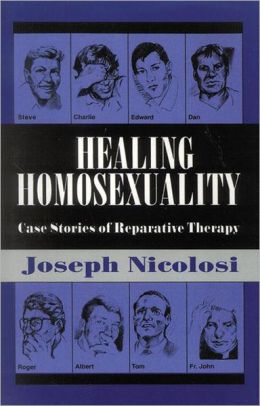
Joseph Nicolosi, Ph.D, a Catholic, is a clinical psychologist at the Thomas Aquinas Psychological Clinic in Encino, California. In 1992, he and two psychiatrists founded NARTH (the National Association for Research and Therapy of Homosexuality). The organization’s membership now exceeds 1,000 worldwide. Dr. Nicolosi’s successes with Reparative Therapy are documented in his books, Reparative Therapy of Male Homosexuality and Case Stories of Reparative Therapy. His interviews with men and women who have left homosexuality, together with testimonials on his behalf are available online.
There are two explanations, Nicolosi reasons, why so many men continue to feel “dis-eased” by their homosexuality: “Either society and the Judeo-Christian ethic have coerced these individuals into thinking they have a problem; or, the homosexual condition itself is inherently problematic.” Dr. Nicolosi finds abundant evidence that the latter is the case. Nonetheless, his work has been made more difficult by social forces that stand firmly by the former position, one that tends to marginalize anyone who adheres to the Judeo-Christian ethic concerning homosexuality.
 In contrast with Dr. Nicolosi’s position, the American Academy of Pediatrics (AAP) has produced a policy statement, “Office-Based Care for Lesbian, Gay, Bisexual, Transgender, and Questioning Youth,” that appeared in the June 24, 2013 issue of Pediatrics. It states that “referral for ‘conversion’ or ‘reparative therapy’ is never indicated; therapy is not effective and may be harmful to LGBTQ individuals by increasing internalized stigma, distress, and depression.” This, of course, is a rather sweeping statement and is at variance with the thinking of other scientists in the field.
The statement also strongly opposes “abstinence-only” approaches to sexuality education: “This expected standard may serve to further isolate and alienate many sexual minority youth [LGBTQ] and contributes risks of personal violence, mental health issues, substance abuse, and risky sexual behavior.” It is at least counter-intuitive, one might say, to think that advising against certain practices would increase their frequency. The policy statement does not note any harmful effects an abstinence-only approach has on heterosexuals.
The policy statement places a heavy blame for the risky behavior that leads to a barrage of adverse effects (illegal drugs, self-inflicted harm, suicidal ideation, suicide, alcohol abuse, unwanted pregnancy, etc.) on “homophobia” and “heterosexism.” It defines the former as an irrational fear and resulting hatred of homosexual individuals.” The suffix “phobia” would indicate the presence of a disorder, one that the statement does not want to apply to homosexual acts. Here it is important to add that the Judeo-Christian principle related to this matter is to love the sinner, but hate the sin.
Heterosexism is defined as “the societal expectation that heterosexuality is the expected norm and that somehow, LGBTQ individuals are abnormal.” The statement goes on to say that “heterosexism is more insidious and damaging” than homophobia. Yet, the position that marriage is exclusively between a man and a woman, until recently, was virtually the consensus of mankind. Why this time-honored tradition is now considered to be exceedingly harmful to a certain group of people requires some basis for understanding. This basis, however, has not been presented.
Small wonder, then, that Dr. Nicholas Cummings, former president of the American Psychological Association has stated that the APA has been “totally hijacked” by the homosexual/lesbian political lobby. “It’s incredible,” he adds; having personally seen “hundreds of people change,” the view that all homosexuality is “hard-wired” and same-sex attraction can never be changed is simply “not supported by scientific evidence.”
The increasing secularization of society together with its enshrinement of political correctness is making it more difficult for Christians to find their rightful place in the world. What can Christians, who want to be faithful to their tradition, do, in good conscience, to function in a secular world in which they finds themselves more and more marginalized, if not ostracized by, for example, position statements of Pediatric Academies? How can a Christian work in the world without compromising his freedom to be a Christian? The Christian understands that by subordinating himself to secular imperatives he endangers his true freedom. What, we may ask, then, is Christian freedom?
Freedom has two dimensions. The first is intellectual and corresponds to Christ’s words, “You shall hear the truth and the truth shall make you free.” The second is more vital, corresponding to the transformation of human nature by the infusion of the Holy Spirit. Christian freedom allows the Christian to know the truth and to live the truth, to know better and to live better. Christian freedom protects him from being absorbed into the secular world. It solidifies his authenticity.
“Like” Truth and Charity Forum on Facebook!
Christopher Dawson prophesied several decades ago that a society structured along the lines of technocracy and economic planning is a kind of totalitarianism in its own right and would bring about “orders of death.” In an article, “Christian Freedom,” (1946), he spoke of the critical value that only the Christian can bring to the world: “If the channels are closed by which the word of Christ and the power of the spirit are communicated to man corporately and individually, the world must fall back into the state of darkness and slavery which Christ came to destroy.” G. K. Chesterton made a similar remark when he said that “The Catholic Church is the only thing which saves a man from the degrading slavery of being a child of his age” (The Catholic Church and Conversion, 1929).
The present situation as a whole and the statements of the AAP in particular offer the Christian a great challenge both for himself and the surrounding world. Dawson and Chesterton remind us that sin can be understood as surrender to slavery. The late Fr. Richard John Neuhaus wrote about “To-the-line University” where courage is abandoned and conformity is required. Thinking about sin in terms of the cowardly enslavement to a secular environment might strengthen a Christian’s resolve to attain the Christian freedom that is needed, not only for personal salvation, but for the betterment of the surrounding world. The research and work of Dr. Nicolosi and NARTH offer a hearty witness to freedom lived authentically in a secular world.
 Dr. Donald DeMarco is a Senior Fellow of Human Life International. Doctor DeMarco is a member of the Pontifical Academy for Life and he is Professor Emeritus at St. Jerome’s University in Waterloo, Ontario and an adjunct professor at Holy Apostles College & Seminary in Cromwell, CT.
He is the author of 22 books, including; Architects of the Culture of Death, The Many Faces of Virtue, The Heart of Virtue, and New Perspectives on Contraception. He has authored several hundred articles in scholarly journals and in anthologies, and articles and essays appearing in other journals and magazines and in newspapers; and innumerable book reviews in a variety of publications.
His education includes: B.S. Stonehill College, North Easton, MA 1959 (General Science); A.B. Stonehill College, 1961 (Philosophy); Gregorian University, Rome, Italy, 1961-2 (Theology); M.A. St. John’s University, Jamaica, NY, 1965 (Philosophy); and Ph.D. At. John’s Univ., 1969 (Philosophy). His Master’s dissertation was “The Basic Concept in Hegel’s Dialectical Method” and his Doctor’s dissertation was “The Nature of the Relationship between the Mathematical and the Beautiful in Music”.
He is married to Mary Arendt DeMarco and they have five children.


