


In a previous article written for Christmas, I reflected on our hope in the Incarnation despite the suffering in the world around us, using Pope Emeritus Benedict XVI’s encyclical Spe Salvi. In fact, suffering can be a “school” of hope, for, when united with Christ, it points beyond our mortality in this life to the eternity of Heaven. Now, as we approach the Holy Triduum, I would like to reflect once again on this theme of suffering through a different lens, through the lens of beauty. This theme was taken up by then-Cardinal Joseph Ratzinger in a message given to the Communion and Liberation group, under the title “The Feeling of Things, the Contemplation of Beauty.”
Ratzinger begins his address by presenting two antiphons for Vespers, one used for the whole year (including Lent) and the other for Holy Week. Holy Mother Church wishes us to contemplate these antiphons together due to their paradoxical descriptions of Christ. The first is from Psalm 44 [45]: “You are the fairest of the children of men and grace is poured upon your lips.” This verse is meant to remind us of Christ’s spousal relationship with His Church, who is not only physically beautiful, but also possesses a higher, spiritual beauty. As Ratzinger explains, “The beauty of Truth appears in him, the beauty of God himself who draws us to himself and, at the same time captures us with the wound of Love, the holy passion (eros), that enables us to go forth together, with and in the Church his Bride, to meet the Love who calls us.” In other words, in Christ, we see the beauty of God, which manifests itself in Love, and we are wounded by this love: this love calls us beyond ourselves to pursue Christ as our Lover.
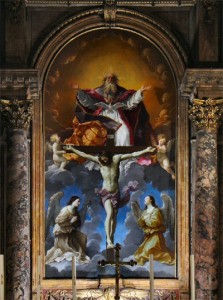 But then, on the Monday of Holy Week, the antiphon changes. We are asked to contemplate Psalm 44 in light of Isaiah 53:2: “He had neither beauty, no majesty, nothing to attract our eyes, no grace to make us delight in him.” Ratzinger questions how we can reconcile this passage with the one quoted above from Psalm 44 [45]. How is it possible for Christ to be both “the fairest of the children of men” and someone without beauty or anything to make us look at Him? Is there somehow an element of beauty in suffering? Indeed, this is a question taken up by the Church Fathers, and even before that, by the Greeks of the ancient world. Ratzinger references both Plato’s Phaedrus and Symposium. Plato believes that “the encounter with beauty [is] the salutary emotional shock that makes man leave his shell and sparks his ‘enthusiasm’ by attracting him to what is other than himself.” According to Plato, man has lost the original perfection within himself, such that he is never satisfied with his daily, mundane life, but is always searching for something more, for that which is beautiful. This in turn causes him to suffer, for his desire for the beautiful can never fully be satisfied; he is always on a quest for that which is beyond himself.
Thus, Platonically, “the arrow of nostalgia pierces man, wounds him and in this way gives him wings, lifts him upwards toward the transcendent.” In the Symposium, Aristophanes discusses the idea that two lovers never fully know what they want from each other, for there is a deeper thirsting for a love not satisfied by sexual pleasure. Aristophanes laments that “the heart cannot express this ‘other’ thing, ‘it has only a vague perception of what it truly wants and wonders about it as an enigma.’” We can see the application of the ancients’ wisdom in our own day, for we live in a culture saturated by sex and physical pleasure. No one is fully satisfied, but always looking for something more, without truly knowing the essence of that “something more.”
With the Incarnation, however, this Platonic understanding of suffering because of beauty finds its fulfillment in the Christian experience. Ratzinger quotes the Byzantine theologian Nicholas Cabasilas: “When men have a longing so great that it surpasses human nature and eagerly desire and are able to accomplish things beyond human thought, it is the Bridegroom who has smitten them with this longing” (Life of Christ, Book II, 15). Christ, the Bridegroom, has given us this longing to be united with Him, true Beauty itself, and this union goes beyond our human nature, which is why only He can satisfy it. “Thou hast made us for Thyself, and our hearts are restless till they rest in Thee,” St. Augustine writes in his Confessions (trans. F.J. Sheed, Book I, Ch. 1). But this longing for and resting in Christ is not “superficial aestheticism and irrationalism.” Rather, “the beautiful is knowledge certainly, but, in a superior form, since it arouses man to the real greatness of the truth.” We gain a particular kind of knowledge when we encounter Christ, the Bridegroom. As Ratzinger writes, “True knowledge is being struck by the arrow of Beauty that wounds man, moved by reality, ‘how it is Christ himself who is present and in an ineffable way disposes and forms the souls of men,’” quoting Cabasilas once again. Therefore, when the Beauty of God, the Beauty of Christ, strikes us, we gain true knowledge, which is not merely superficial or caught up in the human mode of knowing. This knowledge is of Beauty itself, which is why it is most painful. Indeed, it is through this knowledge of beauty that “reason is freed from dullness and made ready to act.” Reason is no longer weighed down by the false beauties of the world but is rather oriented toward Beauty itself.
At this point in his message, Ratzinger returns to the paradoxes presented in the antiphons of the Church: “You are the fairest of the children of men,” and, “He had no beauty, no majesty, to draw our eyes, no grace to make us delight in him.” Bringing together the Greek philosophy and the new Christian experience, Ratzinger writes, “In the passion of Christ the Greek aesthetic that deserves admiration for its perceived contact with the Divine but which remained inexpressible for it, in Christ’s passion is not removed but overcome.” Thus, the Greek understanding of suffering through encountering beauty is not obsolete, but in a certain sense, fulfilled. As Ratzinger writes, “The experience of the beautiful has received new depth and new realism. The One who is the Beauty itself let himself be slapped in the face, spat upon, crowned with thorns.” In taking on lowly human flesh, Beauty itself has suffered, and for this reason, we too ought to enter into that suffering. As we approach the celebration of the Passion, Ratzinger encourages us to allow “ourselves be wounded by him,” allowing the beauty of His suffering to penetrate our souls and thus transform us. Ratzinger is calling us to allow the true knowledge of Christ’s Beauty to form our reason and soul, turning us away from the banal culture and into God’s “marvelous light” (1 Peter 2:9). In Ratzinger’s final words: “Nothing can bring us into close contact with the beauty of Christ himself other than the world of beauty created by faith and light that shines out from the faces of the saints, through whom his own light becomes visible.”
 Veronica Arntz graduated from Wyoming Catholic College with a Bachelor of Arts in Liberal Arts, which included courses in humanities, philosophy, theology, and Latin, among others using the Great Books of Western thought. The title of her senior thesis was, “Communio Personarum Meets Communionis Sacramentum: The Cosmological Connection of Family and Liturgy.” She is currently pursuing a Master of Arts in Theology from the Augustine Institute.


