


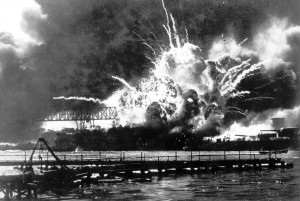
“A day that will live in infamy” was how President Franklin D. Roosevelt announced the bombing of Pearl Harbor on December 7, 1941. To this day, people commemorate that devastating attack which Roosevelt described as “sudden” and “deliberate” with “implications to the very life and safety of our nation.”
People often recall where they were the day President Kennedy was assassinated, or what they were doing when they heard about the terrorist attacks of September 11, 2001. These too, were “days that will live in infamy”.
January 22, 1973 can be considered another day of infamy–the day on which the United States Supreme Court, in the Roe v. Wade and Doe v. Bolton decisions, ruled abortion legal throughout all nine months of pregnancy for virtually any reason. The loss of life since that decision is unfathomable, and our nation has paid the price.
More recently we have added another date to the “infamous list”. On June 26, 2015, the United States Supreme Court ruled in Obergefell v. Hodges that so-called same-sex “marriage” is now the law of the land. Just as I remember that I was at Mass on 9/11 when I heard about the attacks on the World Trade Center, I think I will always recall that, ironically, I was making preparations for our diocese’s Fortnight for Freedom event which was to take place later that evening, when I got the word about Obergefell.
 Many authors have done a superb job in recent weeks, reflecting on the case and its implications, and there is certainly much to be said. Not a few have referred to Obergefell as the Roe v. Wade of marriage. And they would certainly be correct. It will take a while for us to dig ourselves out of the shock of this incomprehensible attack on reality, but perhaps what we’ve learned in the 42 years since Roe can help us in dealing with the dire prospects of what’s to come. Certainly it’s worth reflecting on.
What have we learned from Roe?
Over the past four decades, we have seen 57 million lives lost to abortion and countless mothers, fathers, and families deeply, deeply wounded by abortion’s aftermath. The effects of abortion are well-documented; it is not a pretty picture.
The scourge of abortion on our nation affects all of us. From the personal to the cultural, a heartbreaking devastation has occurred. Despite the strains of apathy, and the currents of advocacy for a woman’s “right to choose” that still persist, we can be encouraged by the forceful response of Christians and many people of good will to right this injustice, as they work to overcome evil with good. The March for Life draws hundreds of thousands of people to Washington, DC on the Roe anniversary in the midst of winter year after year. Pregnancy help centers can be found all over the country, helping women in crisis to choose life. States continue to pass laws that protect the unborn. Project Rachel, the Catholic Church’s ministry of healing and reconciliation to those wounded by abortion, helps women and men find hope and peace in Christ. Thanks to countless efforts of education, pastoral care, public policy advocacy, and above all prayer, the majority of Americans consider themselves pro-life and are acting on their belief that life is sacred.
Yet, we cannot look only at the response to Roe, we must look at other areas of cause and effect as well. The legalization of abortion is not the only factor in the breakdown of marriage, the family, and society.
The sexual revolution of the 1960s and ’70s that included the introduction of the deadly contraceptive pill into modern culture, has taken its toll. One does not have to be a rocket scientist to acknowledge that Blessed Pope Paul VI’s predictions in his landmark encyclical Humanae Vitae in 1968, have indeed come to pass. He told us that if contraception became widespread we would see a general lowering of morality in society, a general disregard for the physical and psychological well-being of females by males, governments using family planning programs for coercive purposes, and, we would begin to treat our bodies as machines, losing respect for the human person as an integral unit of body and soul.
What might be considered the primary lie that fueled so much rejection of Humanae Vitae? Like the legalization of same-sex “marriage”, the lie is in the “re-definition” of an undeniable truth. In the 1960s with the advent of hormonal contraception, the American College of Obstetricians and Gynecologists (ACOG) made the claim that pregnancy begins at implantation (which occurs about a week after conception); but this is blatantly false–as the science of embryology confirms. This redefinition of pregnancy was an insidious attempt to justify abortifacient contraception and abortion procedures. And yet the lie has become so pervasive, even much of mainstream medicine has bought into it.
And this brings us back to Obergefell. Just as scientific evidence clearly demonstrates the truth that life begins at conception, so too do we have the truth about marriage, as the union of one man and one woman, inscribed into our very bodies. As the Catechism states so beautifully, “The matrimonial covenant, by which a man and a woman establish between themselves a partnership of the whole of life, is by its nature ordered toward the good of the spouses and the procreation and education of offspring.” (1601)
Our founding fathers understood the principles of Divine and Natural Law. Right in the Constitution, we find the words, “We hold these truths to be self-evident”. It seems that many in our world have forgotten what this means. Two plus two will always equal four; it cannot equal five just because someone wants it to be that way. If I decide to call Felix the Cat “Birdie”, it will not turn my cat into something he is not. He has the nature of a cat, not a bird. If I expect Felix the Cat to sprout wings and fly, I will be waiting a very long time. It’s just not going to happen because it can’t. So too, re-defining marriage is simply an impossibility. The words of a court decision do not change the reality of what marriage is and has been since the beginning of time.
Just as the effects of Pearl Harbor and Roe had an impact on the very life of our nation, so too will we experience the consequences of the gravely flawed Obergerfell decision. From the persecution already being experienced by those who believe that God is the author of marriage, to the broken hearts of those who inevitably suffer from a grave misunderstanding of what authentic love is – especially children, the Church will remain the steadfast field hospital, inviting all people into a relationship with Jesus Christ who loves us infinitely and has a plan for our lives far greater than we can imagine.
Solutions to our problems lie in acknowledging the truth, repenting of our sins, and growing in holiness. When we sincerely open ourselves to the grace and mercy of God, and take His Word to heart and put it into practice, we can in Christ overcome the evil that plagues us. It isn’t easy, but with God all things are possible. As with defending life – our faithful and courageous witness manifest in education, pastoral care, advocacy for just laws, and much prayer – are going to be vital in defending the self-evident truth of marriage.
We must now seriously ask ourselves: Will we stand up for the Truth? The very soul of our nation may depend on how we answer that question.
 Allison LeDoux is the director of the Respect Life Office and the Office of Marriage and Family for the Diocese of Worcester, MA. Mrs. LeDoux serves as coordinator for the New England region of Diocesan Pro-Life Directors and is a member of the Massachusetts Catholic Conference’s Pro-Life/Pro-Family and Health Care Subcommittees. She received her certification in Catholic Health Care Ethics from the National Catholic Bioethics Center in 2007.Mrs. LeDoux and her husband, John, a permanent deacon, are the parents of eight children.


