


Although the word “shamefacedness” is not frequently heard or used, St. Thomas Aquinas uses the word in his exposition of the virtue of temperance that governs the appetites and desires of the body. Shamefacedness, man’s natural sense of modesty, reacts to the shameful use or display of the body that degrades man to an animal level. Aquinas cites St. Isidore who defines the virtue as “a fear of base action” and quotes St. Ambrose who describes it as “the horror of whatever is disgraceful.”
Temperance, the power that restrains man’s desires in matters of food, drink, pleasure, and sexuality, recognizes the natural distinction between the ordered and disordered use of the body. Overcoming the vices of gluttony, lust, and the urges of the flesh, temperance strives to achieve the golden mean of moderation in which man’s reason rules his desires and orders the body into an integrated whole. With temperance man achieves the balance of moderation that avoids the extremes of “too much” and “too little” (defect and excess). He exercises the virtue of chastity and purity in matters that pertain to the body and acknowledges the value of abstinence, and fasting. In The Four Cardinal Virtues, Joseph Pieper explains the fruit of temperance as beauty: “Not only is temperance beautiful in itself, it also renders men beautiful. Beauty, however, must be understood in its original meaning: as the glow of the true and the good irradiating from every state of ordered being . . . .” Like temperance, shamefacedness is a sign of the beauty achieved by the soul ordering the body.
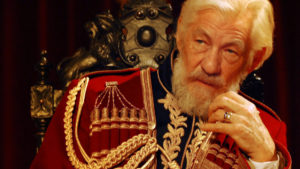
King Lear
Shamefacedness, then, pertains to man’s sense of modesty, decency, and purity with regard to the use, appearance, and meaning of the body. A Christian sensibility does not openly discuss all personal, private, intimate matters as a subject of general interest and information for all others to know. Some matters of discussion belong to conversation between a person and physician or between a person and a priest, not at the dinner table or at a party. Some topics, St. Paul explains, should not even be mentioned in public discourse: “But immorality and all impurity or covetousness must not even be named among you, as is fitting among saints. Let there be no filthiness, nor silly talk, or levity, which are not fitting” (Ephesian 5: 3-4). Shamefacedness always remembers the distinction between the public and the private, the proper and inappropriate, and licit knowledge and curious desire. Because man is an embodied spirit with a soul and a body, St. Paul respects the body as the temple of the Holy Spirit: “Do you not know that your body is a temple of the Holy Spirit within you, which you have from God?” (I Corinthians 6:19. Shamefacedness, then, belongs to the dignity of the human being and distinguishes him from animals. It reflects man’s sense of self-respect and attraction to the noble, honorable, beautiful, and high-minded as the moral norm that befits man’s nature. Anything disgraceful, immodest, shameful, or disgusting is beneath man’s rational, godlike, spiritual being.
Shamefacedness, however, suffers attack in many forms. Films that are rated X, R, and even PG-13 resort to scurrility and nudity as common fare for the moviegoer’s entertainment. Pornography flourishes as a billion dollar industry that flaunts debasing lurid images that cheapen human beings into objects for exploitation. Inappropriate commercials promoting Viagra and similar products during televised athletic events constantly offend common decency. Planned Parenthood’s programs of health and sex education in public schools assault the innocence of the young in the name of information that will presumably protect their health and reduce the risk of disease. Contraception and abortion are marketed to the young as if normative and desirable behavior justified by the law of the land. The explicit, insensitive nature of the educational materials used in this indoctrination shocks and revolts with graphic depictions and coarse language. The blatant, unashamed publicity of the homosexual agenda in the media and schools, the dictatorial presumptions that intolerance of this behavior constitutes “hate speech” subject to penalty, and the legalization of same-sex marriages all trample upon the nature of shamefacedness. Nothing should ever offend a tolerant person. Shamefacedness is not natural but prudish and Puritanical.
The teachings of Christianity and other cultures about purity, self-respect, and dignity have lost their moral authority. The disgraceful, impure, or vulgar carry no stigma and provoke no censure that rouses a sense of disgust at the ugliness of the evils once labeled unspeakable, horrific, or unmentionable. The ultimate insult to shamefacedness is the government decree permitting men and women to use the rest rooms of the opposite sex because of their gender identity rather than their biological sex. In a politically correct world where ideology trumps common decency and moral truth, no human being has any right to object to any form of bodily expression or sexual conduct that he finds objectionable. To judge is to be prejudiced or bigoted. The traditions of civilization, the moral precepts of the Bible or the Catholic Church, and even the wisdom of the ancients carry no moral weight in establishing the normative meanings of decent and indecent, respectable and shameful, or beautiful and ugly. In On Obligations, the Roman Stoic Cicero argues that to discuss bodily functions and sexual conduct in public violates all sense of decorum: “People do not use the precise terms either for the parts of the body which carry out these functions . . . . So neither performing such actions in public nor indecent discussion of them escapes the accusation of immodesty.”
In his treatise on moral duties Cicero upholds the ideal of shamefacedness by praising the ideal of “the honorable” and “the fitting,” explaining that “the fitting is what is consistent with man’s excellence in the respect in which his nature differs from all other living creatures.” The honorable and the fitting oblige man to be modest, and they compare to attraction of the beautiful: “. . . nature has endowed us with the role of steadfastness, restraint, self-control, and modesty.” Just as beauty always appeals to the eye, Cicero adds, “so this notion of the fitting . . . wins the applause of our contemporaries through the regularity, consistency, and control reflected in every word and action.” For Cicero the fitting and the honorable—the pagan sense of modesty and human decency—are always inherently pleasing and their opposites loathsome. Man loses all sense of honor, dignity, and nobility when he discards the propriety of modesty as a mark of man’s exalted nature. To be without modesty amounts to being without appropriate clothing.
As Shakespeare illustrates in King Lear, no moral order can prevail if the distinction between man and animal is not honored. Often the one thing that separates man from animals is the propriety, self-respect, and dignity reflected in clothing. When Lear’s ungrateful daughters demand that he visit them without his one hundred attendants, they provoke their father’s wrath who insists that the servants symbolize the honor due to a king in the same way a woman’s finery and accessories enhance her respectability and worth:
Oh, reason not the need. Our basest beggars
Are in the poorest thing superfluous.
Allow not nature more than nature needs,
Man’s life’s as cheap as beast’s. Thou art a lady.
If only to go warm were gorgeous,
Why, nature needs not what thou gorgeous wear’stWhich scarcely keeps thee warm (II. iv. 268-274).
Lear knows that human beings have a higher and a lower nature. Man can cheapen his life to a beast’s existence by diminishing all the protocols, amenities, and refinements that distinguish men from animals. People wear clothing that not only keeps them warm but also beautifies their appearance and enhances their dignity. When people observe formalities, display manners, and pay respect to kings and fathers, this civility ennobles and refines human conduct and rescues it from the animal instinct of base selfishness. Shamefacedness compares to the attendants who serve Lear and to the regal clothing befitting the daughters of a king. It elevates man’s stature to the rank of a person deserving honor for upholding the highest standards of good taste that distinguish a gentleman and a lady.
In Lear’s phrase, “man’s life’s as cheap as beast’s” he ignores the line that separates the fitting from the inappropriate, the noble from the base, and the modest from the indecent. Just as the eye is designed to contemplate beauty and look above, just as the body is intended to be clothed in tasteful attire and be attractive, and just as man is created to stand erect and be godlike to rise above the animal level, man’s nature is endowed with shamefacedness to react and revolt against anything that cheapens, debases, or compromises man’s honor, self respect, and uprightness. Just as manners provide the foundation for morals and religion accustoms citizens to be law-abiding persons, so shamefacedness raises moral standards and opposes the degeneration of a society that has no sense of shame, modesty, or purity or any idea of the fitting and honorable.
 Mitchell Kalpakgian, Ph.D. has completed fifty years of teaching beginning as a teaching assistant at the University of Kansas, continuing as a professor of English at Simpson College in Iowa for thirty-one years, and recently teaching part-time at various schools and college in New Hampshire. As well as contributing to a number of publications, he has published seven books: The Marvelous in Fielding’s Novels, The Mysteries of Life in Children’s Literature, The Lost Arts of Modern Civilization, An Armenian Family Reunion (a collection of short stories), Modern Manners: The Poetry of Conduct and The Virtue of Civility, and The Virtues We Need Again. He has designed homeschooling literature courses for Seton Home School, and he also teaches online courses for Queen of Heaven Academy and part-time for Northeast Catholic College.


