


With a striking, original metaphor Caryll Houselander in her spiritual classic The Reed of God offers this meditation on the presence and nearness of God in an incarnate world: “The Word of God uttered in Christ’s life is a folk song.” The Incarnation is not only a birth, an historical event, and a miracle but also a song that moves the heart to sing and overflow with joy. A folk song is not specialized music like opera for certain voices or audiences but universal in its appeal to high and low. A folk song is not a complex aria sung by a soprano voice but a simple melody for amateur singers, a music that all can know by heart.
A folk song is a traditional tune everyone knows, remembers, and sings with simple gladness and real affection. The music of the Word of God sings in simple notes, not the elaborate scores of a symphony, a chorus, or a choir—music that requires organization and coordination. The folk song of the Incarnation resounds not to large crowds but speaks “heart to heart”: to Mary and Joseph, to Elizabeth and John the Baptist, to simple shepherds, and to three wise men. It is a song that fills the air with life and a music that charges the world with a heavenly atmosphere that makes all things new.
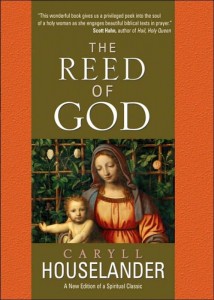 Houselander writes:
The song of the Incarnation is a folk song.
It is the song of the mother rocking the cradle.
It is the song of children singing their nursery rhymes.
It is the song of the shepherd calling his sheep.
It is the song of the lover standing at the door.
It is the song of the bridegroom singing to his bride.
In these universal human experiences of birth, play, work, love, and marriage, Christ lives and acts in these human beings who play the part of Christ-bearer. As Houselander explains, no official groups or organizations “can put life into the world: it can only be born into the world, and only individuals can give birth.” Like the music of a folk song, the sweet voices and cheerful sounds of mothers singing to babies and children laughing fill the heart with the pure joy the Incarnation brought into the world, the joy that made the babe “leap” in Elizabeth’s womb, fill her with the Holy Spirit, and inspire her to cry out “Blessed are you among women, and blessed is the fruit of your womb!” Ordinary people who feel the hand of God in the joy of the family, the fun of children, the meaning of work, the surprise of love, and the blessings of marriage are the voices who carry the tune of this folk song.
A mother’s lullaby by its tenderness comforts and quiets the baby longing for her touch and voice to soothe him. The song of the mother relieves the cries of the fretting child just as Christ’s voice calms the troubled sea when he rebukes the wind and utters “Peace, be still.” The sweetness of the lullaby also is the sweetness of God’s goodness David praises in Psalm 34 (“Taste and see the sweetness of the Lord”). The notes of the lullaby whisper the depths of maternal love that gives vigilant attention and total care to every need of the infant—a glimpse of God’s providential love for each human being loved “as if he were the only one” in Saint Augustine’s words as he marvels at the miracle of birth and the hand of God at the moment of new life: “Their feelings were so ordered that they wanted to give me something of that abundance which they received from you.” The notes of the mother’s lullaby reassure the child of the specialness of maternal love in the way that God’s music calls everyone by name.
The songs of children reciting nursery rhymes resound with the love of life that the Incarnation infuses into the world with Christmas joy. The children who sing or repeat the nursery rhymes never tire of reading them or laughing at the antics of the cow jumping over the moon and dish running away with the spoon. The world is a great adventure with inexhaustible sources of mirth in all the four seasons. The laughter of children is a note in the song of the Incarnation that brings “abundant” life into the world. In At the Back of the North Wind the older brother Diamond delights the baby with the rhymes he recites like ”baby baby babbing/your father’s gone a cabbing/ to catch a shilling for its pence/ to make the baby babbing dance.”
The song of the shepherd calling his sheep is the sound of familiarity, the sounds that make an immense world an intimate, personal home filled with “the voices we know best: our own children’s voices, the voices of our parents, wives, husbands, and friends.” The good shepherd counts each sheep, knows each of them, finds the lost one, and cares for each one. The song of the good shepherd is a note in the song of the Incarnation that proclaims the providential love of God for each soul: “There is providence in the fall of a sparrow.”
The song of the lover standing at the door expresses the longing of the heart’s desire for the intimacy and union of love in marriage. The lover’s music to the beloved is God calling man and woman to cooperate with the great plan of creation to be fruitful and multiply, to donate the gift of self, and to love with an undying love. The lover’s song declares that it is not good for the man to be alone and that God grants to man and woman the deepest desires of the heart. God does not create yearnings in the soul that he does not satisfy any more than God creates thirst but does not supply water. The song of the lover is a note in the song of the Incarnation that resounds with the coming of the long-awaited Messiah that Simeon has been awaiting and now has seen with own eyes and can depart in peace in the fulfillment of this great desire.
“Like” Truth and Charity Forum on Facebook!
The song of the bridegroom singing to his bride echoes the bridegroom’s praises in the Song of Solomon, marveling at the beauty of his bride and contemplating the miracle of her creation (“You have ravished my heart, my sister, my bride, you have ravished my heart with a glance of your eyes”). The bridegroom cannot praise his beloved enough for this most precious gift that astounds the mind. The bridegroom owes this superabundant joy to the God of love that created man and woman for the happiness of marriage in the intimate union that prefigures Christ the bridegroom and the Church His bride. The music of the bridegroom is a note in the song of the Incarnation that celebrates the fruitfulness of love’s abundance.
Happy human voices speaking, singing, praising, thanking, and glorifying God’s presence in birth, work, love, marriage, and the family perpetuate the song of the Incarnation that announces itself to children, mothers, fathers, shepherds, and spouses. Just as, in Houselander’s words, “children playing by the seashore hear the music of the sea in a little shell,” human beings filled with joy carry the tunes that capture the folk song of the Incarnation. This folk song reminds the human race that “human nature can constantly be new; life always young; and everyone bring not death into the world but the miraculous life of the spirit: everyone a bearer of Christ into the world.”
 Mitchell Kalpakgian, Ph.D. has completed fifty years of teaching beginning as a teaching assistant at the University of Kansas, continuing as a professor of English at Simpson College in Iowa for thirty-one years, and recently teaching part-time at various schools and college in New Hampshire. As well as contributing to a number of publications, he has published seven books: The Marvelous in Fielding’s Novels, The Mysteries of Life in Children’s Literature, The Lost Arts of Modern Civilization, An Armenian Family Reunion (a collection of short stories), Modern Manners: The Poetry of Conduct and The Virtue of Civility, and The Virtues We Need Again. He has designed homeschooling literature courses for Seton Home School, and he also teaches online courses for Queen of Heaven Academy and part-time for Northeast Catholic College.


