


The early Church was born into a society that in many ways was divided over the family. The greatest of the Greek philosophers preached a moral code that was nearly identical to the high morality of the early Christians, while at the same time Greek society was rife with sexual immorality of all kinds. Roman culture was similarly divided.
In the early Republic, the Romans held (and mostly practiced) a high degree of moral life with an emphasis on family, fidelity, loyalty, and monogamy. Indeed, I often mention in my classes that the Romans practiced what the Greeks preached.
Yet, as the Republic decayed and imperial Rome took its place, the world came to look more like the salacious Ovid, rather than the upright and traditional Virgil. Both societies were plagued by the practices of abortion and infanticide. Into this society Christianity came bearing its message of the dignity of the person, the goodness of the material world, and the high moral worth of marriage.
From the very beginning Christianity worked to shore up the decaying family life of Late Antiquity. From the writing of the Didache around the year 100, and still within living memory of Christ and the Apostles, there is reference to the evils of contraception and clear condemnation of abortion and infanticide.
The Church has been unanimous in its condemnation of these evils from the very beginning. If there was ever a teaching that fulfills Vincent of Lerins definition of orthodoxy (a teaching taught always, everywhere, and by all) it is surely these moral imperatives of Christianity.
The most stunning fact of the early Church’s approach to family life is often forgotten in the atmosphere of militant feminism and relativism today. The greatest revolution in the dignity of women in the history of the world was the coming of Christianity.
In the vast majority of ancient cultures women were the equivalent of chattels, bought, sold, and traded, they were without a voice. However one can find some trends in favor of women’s dignity among Christianity’s precursors.
 One thinks of the great heroines of Jewish history: female judges like Deborah, or military figures like Jael and Judith. In the Roman republic too women found some measure of dignity and worth, being some of the best treated in ancient world.
One sees this in the Roman value of monogamy, the emphasis on family, chastity, modesty, respect for motherhood, and even some measure of female education. Indeed the Republic was founded on wounded monogamous honor – the tragic figure of Lucretia. Both of these cultures however were in decay, as divorce and other threats to family life became more and more common.
The Church revolutionized the role of women. Women were devoted followers of Christ, and Mary Magdalene had the privilege of announcing the Resurrection to the Apostles themselves (for this she merited the title apostola apostolorum – the “Apostle of the Apostles”). Mary, Christ’s mother, became renowned as the greatest human person ever to live, the “New Eve.”
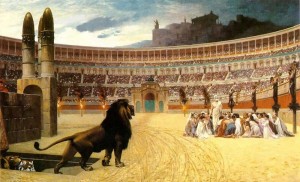
Women laid down their lives with courage in former ages attributed to men alone, and merited for themselves veneration which echoes down the centuries (“Felicity, Perpetua, Agatha, Lucy, Agnes, Cecilia, Anastasia,” sound familiar?). St. Perpetua herself leaves some of the first remaining writings ever authored by a woman. In no culture or religion are women as elevated, respected, and commemorated.
Yet Christianity revolutionized the position of everyday women as well. In a time when women were considered disposable property, Christianity brought the hard teaching of monogamy until death, and equality of guilt in adultery. By banning divorce, the early Church defended the dignity of women as persons, refusing to consider them disposable goods, just as she refused to consider the unborn disposable.
All through the ages the Church has defended this increasingly unpopular teaching, “what God has joined together, let no man put asunder.” The elevation of women went further than that however, for Christianity demanded freedom. A woman is not a piece of property to be bartered between father and spouse (though their choices remained significant for all of later history). A woman’s free consent was irreducibly important for Matrimony.
In any other culture, there would be no scene of Old Capulet throwing a fit because Juliet would not consent to marry Paris — anywhere else it was simply inconceivable for a marriageable woman to refuse her father’s wishes. But the dignity of women went further still. The Church safeguarded their right, just like that of men, to choose a more perfect way and refuse marriage entirely. They could not be forced to marry. This was social revolution. Women for the first time had a right of self-determination, rooted in their Christian freedom. They could refuse to marry, enter a convent, and increasingly, become educated. Some became powerful leaders in Church and state in this manner.
As an example of the early Church’s approach we have the case of Pope St. Calixtus I (r. A.D. 217-222). We possess no writings from him, only vicious polemics penned by his enemies Hippolytus and Tertullian. Calixtus had hewed to the great Christian middle between rigorism and laxity. He permitted those who had sinned sexually to return to the Eucharist, after suitable penance. For this, his puritanical enemies excoriated him and called him the vilest names, merely for remembering the story of Christ and the adulterous woman.
Calixtus further emphasized the dignity of women when he permitted marriages between noble Roman women and men of lower social classes – unthinkable in ancient Rome – even though those marriages violated Roman Law. In so doing Calixtus asserted the right of the Church to have jurisdiction over the sacrament of marriage.
Some have called this the Church’s emancipation proclamation from state control. The state did not have authority over the sacraments, only the Church did. The state could not rewrite what it thought marriage should be, for that was above and beyond the temporal power. For this Calixtus’ enemies attacked him too. In every age the Roman Church has held the dignity of women, the sacredness of marriage, and the inviolability of family life. The writings of St. Calixtus’ enemies are a better testimony to his greatness and holiness than the most florid and flattering epitaph could ever be.
Without the Catholic Church women would not have been able to experience the liberation of personhood (which is itself a Christian term). The Catholic Church should be celebrated as the liberator of woman, not as her oppressor. Even today, when the Church is seen as anti-woman, she still, after 2000 years, is defending their personhood and their dignity, in marriage, in sexual morality, and in the public square.
 Donald S. Prudlo is Associate Professor of Ancient and Medieval History at Jacksonville State University in Alabama. He is also Associate Professor of Theology and Church History at Christendom. His specialty is Saints and Sainthood in the Christian Tradition, and he is the author of The Martyred Inquisitor: The Life and Cult of Peter of Verona (+1252) (Ashgate, 2008) and has recently edited The Origin, Development, and Refinement of Medieval Religious Mendicancies (Brill, 2011).


