


There are a number of philosophical theories about the origin of human society. There are two extreme positions.
One is the Social Contract theory dear to Hobbes and Rousseau which maintains that in the beginning there was no society. Man was totally free. Because of evil, human beings banded together to form social contracts which like a plank to a shipwrecked man saves people from the evil tendencies of others. Society is simply a convenience in this theory, which one should be able to do without but necessity requires for survival.
The other extreme is the Marxist or totalitarian theory, which holds that man has such a strong social nature that he has no individuality. Man is simply a cog in a giant machine and all his acts are social. Society is a part of his substance.
 The position of the Church has been quite different.
Following philosophers like Aristotle, the Church has maintained that man is by nature social. This social character is not of his substance. It is a property of human nature because man has a spiritual soul and freedom.
As Blessed Pope John Paul II was fond of pointing out using what he called the “personalistic norm” explained in Gaudium et Spes no 24:3: no human person is an object of use but must be a subject of love, and the human person only finds himself in a sincere gift of himself to another. Society is the place where this gift is given and received.
There are many societies depending on what the good is that the members pursue. In fact, it is this good which forms the nature of one society as opposed to another. This good, also called the “common good” is not just the sum total of the private goods of the members, but it obliges them to go outside themselves to practice a good and form their character in the way they could not do if left merely to themselves.
This common good or purpose shapes the kind of authority and institutions necessary to pursue the goods in question. Most of these goods are temporary and incidental. Three are permanent and every human person must be a member of the societies they pursue in order to perfect his soul. They are the family, the state, and the Church.
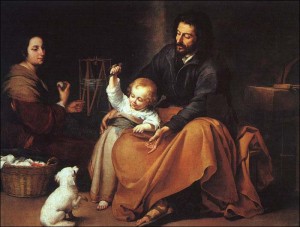
The family is oriented to the good, which is the unity of the parties which turns around the relationship of procreation and education of children. To pursue this goal there must be peace among the spouses and peace in the home. A proper authority structure insures this.
Men must truly be fathers, who offer both spiritual and emotional support to women and children. This includes intellectual affirmation in the adolescent years. This is especially realized in telling the truth.
Women must be mothers, who emotionally support both their husbands and children by an empathy born of love. She also must tell the truth.
The economic order participates in the goal of the family and is an extension thereof. The just wage, which is necessary to reward work and offer some stability in the home, with freedom from want is essential to this. The goods and services provided by business are also necessary.
The state has as its final purpose providing a climate of peace and order in which families and businesses can successfully provide the support needed for the material and spiritual welfare of the family. Authority in the state must be of the sort that the particular society may pursue the justice and rights of the citizens. It cannot subsume the family or the individual into itself. Nor should it pursue its private good to the expense of the common good. That being said, it could be a monarchy, oligarchy, or democracy, or combination of all three.
The purpose of the Church is to lead people to heaven. In fact, the Church is not a natural society which can be founded by human beings because her common good is heaven, and grace is the means to pursue this goal. Accordingly, Church authority is a hierarchy of service based on grace founded directly by God.
In Catholic social teaching there is a famous principle called “subsidiarity.” This is the Church’s recognition of the necessity of all three of these societies. It also entails the judgment that small is beautiful.
It would not be fitting for the higher society to assume the functions and powers of the lower society. This would cause social disorder.
“Like” Truth and Charity Forum on Facebook!
So it is not appropriate for the state to be the primary educator or health provider. These belong to the family. The place of the state is to encourage business and the family to pursue their characteristic goals and not to try and supplant them.
The state is too huge already, and no human society can expertly provide every human service. If the state makes laws about business or the family these should be to encourage each to do its proper task in encouraging human good.
The Church also must not seek to supplant the state or the family as happens in a theocracy. Instead, the Church encourages the state to obey the natural law and so to pursue its proper good. The Church may certainly teach what that law demands and may also instruct families in their obligations, but it would be unfitting for the Church as a society to absorb the other two or have clerics running them on a regular basis.
The present tendency in Europe and America to replace the family and business with the nanny state is completely disordered. It undermines both the family and business. Since these are the cornerstones on which civil peace is based and maintained, the state also undermines itself. It must be reversed for there to be true peace and domestic tranquility.
 Father Brian Thomas Becket Mullady, O.P. is adjunct professor at Holy Apostles Seminary in Cromwell, Connecticut. In 1966, he entered the Dominican Order and he was ordained a priest in Oakland, California in 1972. Father Mullady received his Doctorate in Sacred Theology (STD) from the Angelicum University in Rome, Italy, where served as a professor for six years. He has taught at several colleges and seminaries in the United States and is an academician of the Catholic Academy of Science, the theological consultant to the Institute on Religious Life, and the author of the Question and Answer column in Homiletic and Pastoral Review. He has been featured in several series on Eternal Word Television Network (EWTN). The author of three books and numerous articles, Fr. Mullady has served as a parish priest, high school teacher, retreat master, and mission preacher.


