


The pro-life movement has adopted several saints as patrons over the years. These patron saints certainly provide the necessary intercessions that the pro-life movement needs, but there is another saint that should be seen as an exemplar of the movement as well. During a time of persecution where it was dangerous to be a Christian, St. Sebastian’s deeds speak heroically of his pro-life views regarding the sanctity of human life. He gave his voice to those who did not have a legal say within the Roman Empire.
While St. Sebastian at first glance may seem an odd choice since he is known as the patron for athletes and soldiers, his story is uniquely suited to become a pro-life patron. Consider some basic facts about what is known about this saint’s life. While most people are aware that he served in the Roman army (hence the reason why he is a patron for soldiers) and that he was executed for being a Christian, most people are unaware of what exactly he did.
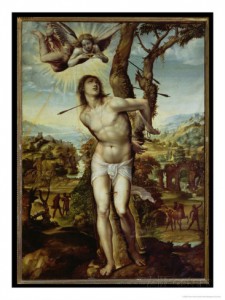 Tradition holds that St. Sebastian died around 288 A.D. This was just before the time of the last Great Persecution of Christians within the Roman Empire. Essentially, being a Christian amounted to treason since the faith did not recognize the Emperor as a god. As a result, Christians had no real legal rights under Roman law. If a person were found out to be a Christian he was given a choice: 1) make sacrifice to the Emperor (which would be a form of idolatry) or 2) be executed. As a result of this quandary, St. Sebastian lived in a time when it was prudent to be a Christian in secret.
This great martyr for the faith went from being a mere Roman soldier to the Emperor’s Praetorian Guard, to captain of that very guard all the while being a clandestine Christian. Imagine the Emperor Diocletian’s surprise when he found out that his very own captain of his royal bodyguard was a Christian. Of course, when his faith was discovered, St. Sebastian was given the choice to choose either God or the Emperor and his first martyrdom is a testimony to his decision.
He was taken outside of Rome, tied to a tree, shot full of arrows, and left for dead. But, interestingly, he survived that execution attempt. He was nursed back to health and what he did next defies what most people would have done. Typically, most people would have remained silent for fear of facing death again. But St. Sebastian did not travel to some remote region of the Empire to live out his remaining years in secret. After he regained his vigor, he went to publicly denounce the Emperor Diocletian’s persecution of Christians. Not only did he just do this publicly, he did it in front of the Emperor. This is the action that deserves the attention of pro-life legislative advocates, for it is here that one can see a saint advocate for the lives of the defenseless before governmental authority. Yet, St. Sebastian knew that his advocacy would most likely end in his second martyrdom which he did bravely face again. This time he was clubbed to death.
Those who lobby the legislatures on behalf of the pro-life movement know all too well that they face a potential persecution of their own, especially in states where the legislature is not friendly towards the Culture of Life. While it is true that those who lobby today will not be shot with arrows or beaten to death with clubs, they are victimized in other ways. The first is rejection of the message. No doubt, St. Sebastian held the hope that Diocletian would accept Jesus as his Lord and Savior, but he also knew that it was very possible the Emperor would not. Those who lobby for the pro-life cause certainly face the very same dilemma. It should be noted here, however, that St. Sebastian also understood what the real meaning of the term “martyr” was as well. In Greek it means “witness”. Not only do Christians see a man who exemplifies the virtues of fortitude and faith in his two attempted executions, but people can also see how St. Sebastian is a witness to the Catholic Faith in his action, speaking to the Emperor. This action took much courage and it is not always an easy thing to speak to those who have public authority. Again, like St. Sebastian, pro-life legislative advocates may have to take a message of truth of defending the defenseless to hostile offices. This is true regardless of the state and most especially true in states where the legislature is most hostile to the message of the Culture of Life. Yet nonetheless, these advocates for Life still speak on behalf of the most defenseless in our society hoping that the message will not just be heard, but accepted.
St. Sebastian yearned for his own country to accept a Culture of Life. He certainly understood what St. John Paul II stated centuries later in his encyclical The Gospel of Life, “The Gospel of life is not for believers alone: it is for everyone” (see. No. 101). St. Sebastian understood this and that is why he went to speak to Diocletian. He knew that, in many ways, it was his duty to bring the Gospel of Life to his Emperor. Those who lobby on behalf the pro-life movement are given the same task. They too have the duty to bring that very same Gospel message to the various legislators they must work with. It is with no doubt, because of this, that pro-life legislative advocates have an exceptional model to fashion themselves after. There is no doubt that St. Sebastian will intercede on their behalf.
 Joe Kral has been involved in the pro-life movement since he has been in college. His MA in Theology was completed at the University of St. Thomas where he specialized in bioethics. From 1996-2003 he was the Legislative Director for Texas Right to Life. During that time he was also a lobbyist for the Department of Medical Ethics at National Right to Life. From 2004-2007 he consulted the Texas Catholic Conference on pro-life legislative initiatives. In 2006 he was awarded the “Bishop’s Pro-Life Award for Civic Action” from the Respect Life Ministry in the Diocese of Dallas. He currently is an adjunct professor of Theology at the University of St. Thomas, teaches FTCM courses for the Archdiocese of Galveston-Houston, and also serves as a voluntary legislative advisor to Texas Alliance for Life. He has been married to his wife, Melissa, since 2004 and attends St. Theresa’s Catholic Church.


