


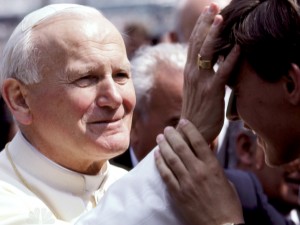
While it may seem obvious at first, understanding the family is intrinsically linked with understanding the person. If we have a false understanding of the person, viewing him as an end to our actions or even strictly as a cog in the machine, then we will likewise have an incorrect understanding of the family, for the person is the fundamental unit of the family. Therefore, as we celebrate the feast day of Pope St. John Paul II, it seems appropriate to revisit the definition of the person in order to understand how he or she fits into the family, which, as Karol Wojtyła/Pope John Paul II defined it, is the communio personarum (communion of persons).
During the time that he taught at the University of Lublin in Poland prior to his election as Supreme Pontiff, Wojtyła gave a lecture entitled, “The Person: Subject and Community,” and we shall turn to this essay in order to gain a proper understanding of the person. This essay acts as a concise version of his much larger work, The Acting Person (Osoba I Czyn—Person and Act), and Wojtyła’s purpose is to respond to both Immanuel Kant and Max Scheler’s philosophies regarding man. He begins by saying that, “in the field of experience, the human being appears both as a particular suppositum and as a concrete self, in every instance unique and unrepeatable.”
 The human being is at once a subject experiencing himself and a subject that being experienced by others. Thus, Wojtyła writes that the human being is “simultaneously its subject and object.” As such, the human person does not simply exist autonomously, but also in relation to others. He continues: “The experience of existing and acting is something that all human beings, both others and I, have in common; at the same time, all human beings, both others and I, are also the object of this experience.” Therefore, the human person does not simply exist by himself as a subject but shares with all others the common ability to act based upon the interior principle of the will. All human beings experience existence by themselves, but, because of that, they are also sharing that experience with all others.
We see that experience is central to understanding the person. As Wojtyła continues:
By saying that the suppositum is the fundamental expression of the whole experience of the human being, I mean that this expression is in some sense an inviolable one: experience cannot be detached from it, and, at the same time, that it is open to everything that the experience of the human being, especially the experience of one’s own self, can bring to the understanding of the subjectivity of the person.
In other words, the experience of the human person helps to reveal his essence, but, at the same time, his understanding from experience continues to grow as he learns about himself. Through these two ways of experience, the individual comes to a greater understanding of subjectivity—a greater understanding of himself. Necessarily bound up with understanding experience is the importance of action in the human person. In fact, Kenneth L. Schmitz, in a series of Michael J. McGivney lectures of the John Paul II Institute for Studies on Marriage and Family, comments that this understanding of action is the missing factor from both Kant and Scheler’s philosophies. Wojtyła writes, “The human being is revealed as a person mainly in and through action.” Therefore, “The human being as a person is constituted metaphysically as a being by the suppositum, and so from the very beginning the human being is someone who exists and acts.” This human action (actus humanus) defines him as an individual and allows him to interact with others, and he thus participates in the objective field of existence.
Furthermore, Wojtyła writes, “In singling out action, or human operari, as the form of human dynamism that best enables us to know the human being as a personal subject, the first thing we should note is that this action is conscious activity.” And, we can argue that this “conscious activity” is linked with his interior principle, or his interiority as a subject, which means that the person’s interiority allows him to interact with others. In a way, we could say that his interaction with others allows him to participate in conscious activity in the objective realm of existence. As Wojtyła wrote in Love and Responsibilty:
The human person, as a distinctly definite subject, establishes contact with other beings precisely through his interiority, whereas the whole ‘biological’ contact, which also belongs to him—for the person possesses a body and even in a sense ‘is a body’—and the sensual contact in the likeness of animals does not constitute for him the characteristic ways of connecting with the world.
While Wojtyła would be the last theologian/philosopher to deny the necessity of the body in human interactions, at this point in his argument, he chooses to emphasize the importance of the interiority of the human person as the way he or she connects with other human beings. Because a person is able to self-reflect and have an interior gaze into the way that he acts, he can look at another and understand how he acts as his own individual person, since both share the same humanity. Because the human is both subjective and objective, he experiences others through the experience of himself, and he experiences himself through his experience of others.
If we consider the human subject through both the subjective and objective lens, we find that he is incapable of understanding himself autonomously. Man’s interior experience is connected with his experience of and action with others. Therefore, in the second part of this essay, we shall follow these philosophical musings to their natural conclusion and consider man as he participates in community, for, as the title of Wojtyła’s essay suggests, the person is both a subject and a communal being. As Wojtyła will argue, not only is man capable of living in community, but he is also naturally able to live in communion with others, and from that, we shall see how the most natural and fundamental social communion is the family.
 Veronica Arntz graduated from Wyoming Catholic College with a Bachelor of Arts in Liberal Arts, which included courses in humanities, philosophy, theology, and Latin, among others using the Great Books of Western thought. The title of her senior thesis was, “Communio Personarum Meets Communionis Sacramentum: The Cosmological Connection of Family and Liturgy.” She is currently pursuing a Master of Arts in Theology from the Augustine Institute.


