


In the opening lines of his Confessions, St. Augustine famously writes, addressing our Lord, “For Thou hast made us for Thyself and our hearts are restless till they rest in Thee” (trans. F.J. Sheed). In one sentence, Augustine summarizes the longings of the human heart and the purpose of life: man is not made for this world, because he is destined for union with God and to experience the Beatific Vision for all eternity. Indeed, Augustine’s early life is an example of restlessness, for he aimlessly sought the transient pleasures of this life without receiving satisfaction. Not until he finally listened to these words from mystical voices, “Tolle et lege, tolle et lege (Take and read, take and read),” did he finally find peace in putting on the Lord Jesus Christ, rather than allowing himself to be weighed down by sin (cf. Romans 13:13-14). What is this divine love that Augustine experienced and brought him to a radical conversion? Is it possible for us to experience it as well?
As Augustine discovered, the restlessness of the human heart is not satisfied by the lusts of this world, but rather by the burning love of Christ, for He longs for each person to be one with Him, a union that can only be realized fully in Heaven. Pope Emeritus Benedict XVI, who is an Augustinian theologian, discusses this divine burning love in the first part of his encyclical, Deus Caritas Est. Benedict opens his encyclical by noting the problem of using the word “love” in a multitude of ways, to the point that it is impossible to know the differences between the definitions. To understand love, he says we must ask the following question, “Are all these forms of love basically one, so that love, in its many and varied manifestations, is ultimately a single reality, or are we merely using the same word to designate totally different realities?” (2).
 To begin answering this question, Benedict discusses three different Greek words used to describe love: eros, philia, and agape; for our purposes, we shall discuss eros and agape. Of eros, Benedict writes,
The Greeks—not unlike other cultures—considered eros principally as a kind of intoxication, the overpowering of reason by a ‘divine madness’ which tears man away from this finite existence and enables him, in the very process of being overwhelmed by divine power, to experience supreme happiness (4).
This intoxication can easily become sexual and undisciplined. Moreover, rather than being an “ascent in ‘ecstacy’ towards the Divine,” it can become “a fall, a degradation of man” (4). According to Friedrich Nietzsche, eros was destroyed by Christianity’s agape, which, given Christ’s Gospel message, was seemingly something radically different from eros. Agape “seeks the good of the beloved: it becomes renunciation and it is ready, and even willing, for sacrifice” (6). But, modern man sees this kind of love as something lower than eros, as Benedict summarizes in the following question: “Doesn’t the Church, with all her commandments an prohibition, turn to bitterness the most precious thing in life? Doesn’t she blow the whistle just when the joy which is the Creator’s gift offers us a happiness which is itself a certain foretaste of the Divine?” (3). It would seem, then, that unified love does not exist. There is the sexual love of eros, which leads to pleasure and intoxication, and there is the Christian agape, which requires sacrifice and suffering for another.
Nevertheless, of this belief that amor concupiscentiae (eros) and amor benevolentiae (agape) are fundamentally opposed, Benedict says, “Were this antithesis to be taken to the extremes, the essence of Christianity would be detached from the vital relations fundamental to human existence, and would become a world apart, admirable perhaps, but decisively cut off from the complex fabric of human life” (7). He then continues: “Eros and agape—ascending love and descending love—can never be completely separated. The more the two, in their different aspects, find a proper unity in the one reality of love, the more the true nature of love in general is realized” (7). Thus, Benedict affirms, “‘love’ is a single reality” (8), for we cannot separate the two kinds of love. We discover this reality in the fact that the God of Israel “loves with a personal love” (9). He created man completely out of His goodness and then beckoned him onto Himself, as seen in the metaphors of betrothal and marriage used to describe God’s relationship with Israel (cf. 9).
Based upon these ideas, Benedict makes the radical claim:
God is the absolute and ultimate source of all being; but this universal principle of creation—the Logos, primordial reason—is at the same time a lover with all the passion of a true love. Eros is thus supremely ennobled, yet at the same time it is so purified as to become one with agape (10).
The God of all creation is a passionate lover: He yearns for man and, indeed, for all of creation, to be united to Him, as a husband and wife long to be united. The marriage of husband and wife is an image of God’s radical and divine love (as seen in the Old Testament), for the two yearn to be united in one flesh, as we recognize in Adam’s exclamation when he is first introduced to Eve: “This at last is bone of my bones and flesh of my flesh” (Genesis 2:23). As Benedict says, this indicates that “eros is somehow rooted in man’s very nature,” and “eros directs man toward marriage, to a bond which is unique and definitive” (11). In this way, “God’s way of loving becomes the measure of human love” (11), for it us deeper into His own heart.
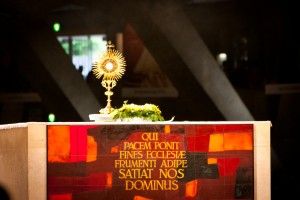
The ultimate union of eros and agape is seen in the Eucharist, which is the gift of Christ’s own Body and Blood to mankind. The “divine activity” of the Old Testament “takes on dramatic form when, in Jesus Christ, it is God himself who goes in search of the ‘stray sheep,’ a suffering and lost humanity” (12). As such, God’s eros shines through in Christ seeking out man, who has gone astray through his sin. But, at the same time, His agape love is made present in the Cross, which has an “enduring presence” in the Eucharist (13). As Benedict writes, “The imagery of marriage between God and Israel is now realized in a way previously inconceivable: it had meant standing in God’s presence, but now it becomes union with God through sharing Jesus’ self-gift, sharing in his body and blood” (13). In other words, God’s passionate love for mankind of fully realized in the gift of the Eucharist, in which He repeatedly gives Himself to us and unites Himself with us.
As we approach the feast of Corpus Christi, the solemn feast that celebrates the sacred Body and Blood of our Lord Jesus Christ, let us conclude with the following words from Benedict:
Communion draws me out of myself towards him, and thus also towards unity with all Christians. We become ‘one body,’ completely joined in a single existence. Love of God and love of neighbor are now truly united: God incarnate draws us all to himself. We can thus understand how agape also becomes a term for the Eucharist: there God’s own agape comes to us bodily, in order to continue his work in us and through us (14).
We find that this love is the love that Augustine referred to when he said that our hearts are restless until they rest in the Lord. Our hearts are longing to be united with Christ in the Eucharist, and we are only truly satisfied when we partake of the Communion of His Body and Blood. With great rejoicing, then, let us approach the banquet of the Lord as we give thanks for His Body and Blood.
 Veronica Arntz graduated from Wyoming Catholic College with a Bachelor of Arts in Liberal Arts, which included courses in humanities, philosophy, theology, and Latin, among others using the Great Books of Western thought. The title of her senior thesis was, “Communio Personarum Meets Communionis Sacramentum: The Cosmological Connection of Family and Liturgy.” She is currently pursuing a Master of Arts in Theology from the Augustine Institute.


